You're probably here because you've typed “water birth Dubai” into your phone at midnight, opened six hospital pages, and still feel unsure. One page says it's gentle and calming. Another gives broad rules. What's often missing is the practical part. Who qualifies, what hospitals really check, and what happens if your labour changes on the day.
That uncertainty is normal. If you're pregnant in Dubai, or supporting someone who is, you want calm information, not hype. You may also be thinking ahead to life after birth, including simple home basics like keeping clean drinking water UAE families can rely on close at hand, especially if you live in Dubai, Sharjah, or Ajman.
Table of Contents
- Is a Water Birth in Dubai Right for You
- Understanding Water Birth What It Is and How It Works
- Benefits and Risks A Balanced Look for UAE Parents
- Navigating Hospital Policies and Eligibility in Dubai
- Your Pre-Birth Planning Checklist and Key Questions
- Hydration and Postpartum Care
- Your Next Step A Gentle Birth and Easy Hydration
- Frequently Asked Questions About Water Birth in Dubai
- Can my partner stay with me during a water birth?
- Does water birth mean I must deliver in the water?
- What if something changes during labour?
- How do I know if I'm a suitable candidate?
- Is water birth available outside Dubai?
- Should I prepare my home before the birth?
- Is it worth arranging water delivery before the baby arrives?
Is a Water Birth in Dubai Right for You
A lot of parents first hear about water birth through a friend, a doula, or a short hospital reel online. It often sounds lovely in theory, but then real questions show up fast. Is it safe? Is it only for certain pregnancies? Will your doctor support it?
In Dubai, water birth isn't just an idea people talk about online. It's part of real hospital maternity care for selected pregnancies. That matters, because it means you're not exploring something fringe. You're looking at an option that sits inside a structured medical setting.
The first question isn't comfort
The discussion often starts with pain relief, but the first useful question is this: are you likely to be eligible? If your pregnancy is straightforward and your baby is well positioned, the conversation may move forward. If there are medical concerns, your team may guide you toward a standard labour room instead.
That doesn't mean something has gone wrong. It means good maternity care adjusts to your needs.
Practical rule: Water birth works best when you hold two ideas at once. You can want a calm, low-intervention birth and still be fully open to medical changes if labour asks for them.
Dubai families often need local answers
Many parents frequently encounter a challenge. General birth advice from abroad doesn't always answer Dubai-specific questions about hospital policies, referrals, or how decisions are made during labour. That's also true for families living nearby in Sharjah or Ajman who may be planning birth care in Dubai.
A simple example helps. One mother may be told she's a good candidate at a routine visit. Another may be interested in the same option but needs more review because of details in her pregnancy history. On paper, both may sound “low risk”. In real life, hospitals look closely at the finer points.
Here's the mindset that usually helps most:
- Stay curious: Ask your provider whether they personally support water labour, water birth, or both.
- Stay flexible: Your birth preferences matter, but labour can change quickly.
- Stay practical: Think about the full experience, including transport, support people, hospital bag items, and your recovery at home.
For some parents, water birth in Dubai feels like the right fit from the start. For others, it becomes one option among several. Either way, the best decision is usually the one that leaves you feeling informed, supported, and calm.
Understanding Water Birth What It Is and How It Works
A water birth means part of labour, birth, or both takes place in a pool of warm water. That basic definition appears in reporting on Abu Dhabi's first recorded water birth at Burjeel Hospital in 2024, noted in this report on Abu Dhabi's first recorded water birth.
The pool changes the labour environment
Many parents hear the term and picture something more dramatic than it usually is. In practice, it is still hospital care. The main difference is that some stages happen in warm water instead of only on a bed or in a standard labour room setup.
The feeling is similar to getting into warm water when your whole body has been holding tension. Muscles often soften. Your body feels lighter. Positions that seemed awkward on land can feel more natural in the pool.
That does not remove the work of labour. It changes the setting in ways that may make contractions easier to cope with.
For many women, the pool helps in three practical ways:
- Warm water may ease tension: A body that is less tight often works with contractions more comfortably.
- Buoyancy supports movement: Kneeling, leaning forward, squatting, or turning can feel easier when the water carries part of your weight.
- The room often feels quieter: That calmer atmosphere can help some parents focus one contraction at a time.
Water labour and water birth are not always the same thing
This point causes confusion in Dubai clinics and hospital tours more often than parents expect. Some providers use "water birth" as a general term for labouring in water. Others use it only when the baby is born underwater.
That difference matters because a hospital may allow one option but not the other. You might be encouraged to use the pool for pain relief in active labour, then be asked to come out for delivery. Another hospital or doctor may support staying in the pool for the birth itself.
If you are discussing this with your care team, ask them to define both terms plainly. It is a small question, but it can prevent a big misunderstanding later.
Some women use the pool during labour and then leave it for birth. Others remain in the water for delivery. Your provider may support one, the other, or both.
What usually happens on the day
A water birth room is set up for comfort, but it is also set up for observation. Midwives and doctors still keep track of how labour is progressing and how the baby is tolerating labour. Warm water is part of the care plan, not a break from medical care.
The process usually follows a simple rhythm:
- Labour is established and your team checks that the pool is still a suitable option at that point.
- You get into the pool once the timing is right, rather than too early, and try positions that feel steady and comfortable.
- Monitoring continues while your team watches your contractions, your progress, and the baby's wellbeing.
- Your plan is reviewed in real time if labour speeds up, slows down, or if there is any reason to leave the water.
That last step is especially important in Dubai hospitals, where policies are often shaped by the specific consultant, midwifery team, and facility protocols. Parents sometimes expect a fixed package. It usually works more like a live care plan that can be adjusted if labour changes.
A good way to picture it is this. The pool is one tool in the room. It can be a very helpful tool, but your care team still decides with you whether it remains the right fit as labour unfolds.
Benefits and Risks A Balanced Look for UAE Parents
You may love the idea of warm water and still feel unsure. That is normal. Many Dubai parents are weighing two things at once. They want a gentler labour experience, and they also want to know exactly how hospitals handle risk if the plan changes.
For low risk, full term pregnancies, water during labour is often discussed as a comfort measure first. Mediclinic City Hospital's water birth guidance explains that the pool helps support much of the mother's weight and may be used for healthy women with uncomplicated pregnancies at term. That matters because labour is physical work. If your body is carrying less strain, it can be easier to relax, breathe, and keep changing position as contractions build.
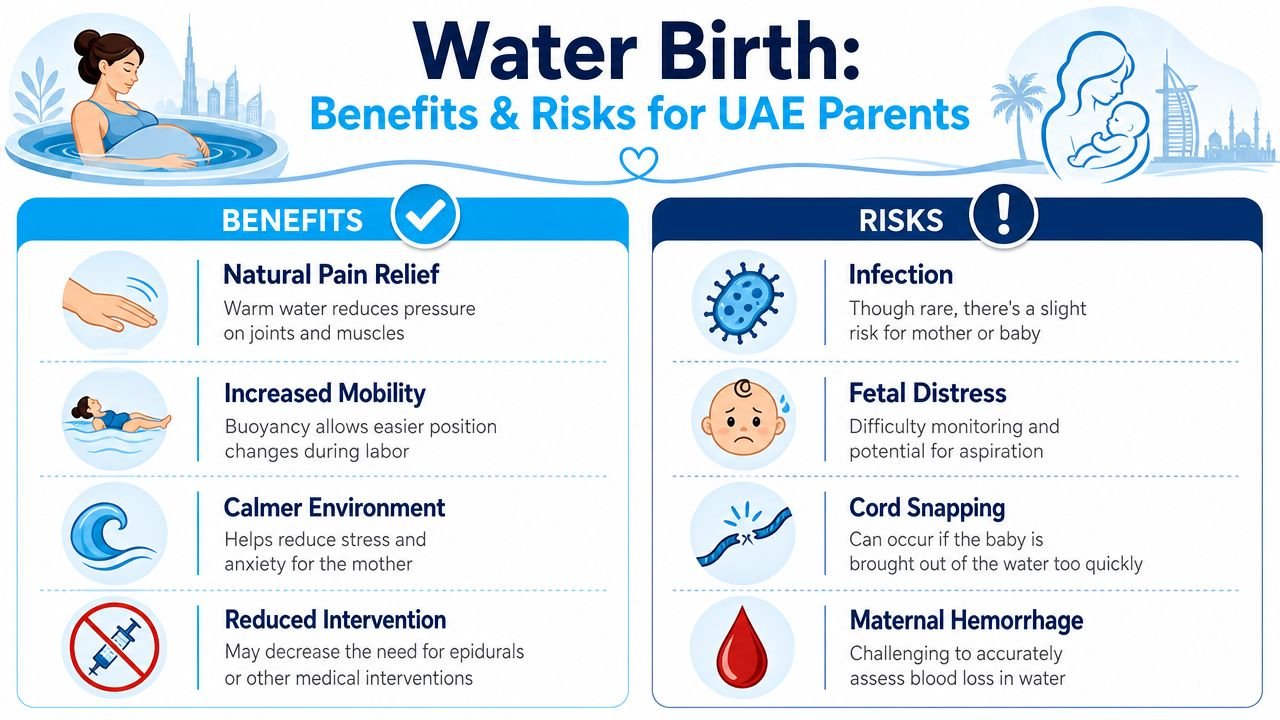
The benefits parents usually feel in real life
The first benefit is often simple relief.
Warm water works a bit like taking pressure off a sore back by floating in a pool. You are still doing the work of labour, but your muscles are not fighting gravity in the same way. That can make contractions feel more workable, especially if you have been tense, exhausted, or stuck in one position.
Parents commonly value water labour for a few practical reasons:
- Comfort: Warm water may soften the feeling of pressure and intensity.
- Freedom to move: It is often easier to kneel, lean, squat, or turn in water than on a bed.
- Privacy and calm: The room often feels quieter and less exposed, which can help some women stay focused.
- Less intervention for some women: Reviews often report lower use of some pain relief during water labour, though this varies by person and by hospital protocol.
That calmer feeling is not a small detail. Labour hormones tend to work best when a woman feels safe, supported, and able to settle into the rhythm of contractions. In a busy Dubai hospital, the pool can sometimes create a protected space inside a clinical setting.
To get a visual sense of how many families think about this choice, this short video is a helpful starting point.
The risks parents usually ask about
The harder questions matter just as much. Can the baby breathe in water. What if labour slows down. What if you start bleeding more than expected. These are sensible questions, and good maternity teams should answer them clearly.
The practical answer is that water birth is not treated as a free for all. It works more like using one room in the hospital that comes with extra rules. Staff still assess progress, maternal wellbeing, and signs that tell them whether staying in the pool continues to make sense. If something changes, the team may ask you to leave the water for closer assessment, stronger monitoring, or birth on land.
Common concerns include:
- Infection control: The tub and equipment need careful cleaning and clear hygiene protocols.
- Bleeding after birth: If there are concerns about postpartum bleeding, your team may want you out of the pool quickly for treatment and estimation of blood loss.
- Baby wellbeing: If monitoring raises concern, land birth may become the safer option.
- Labour progress: Slow progress, meconium, rising temperature, or maternal exhaustion can change the plan.
Dubai-specific planning is particularly beneficial. Hospitals in the UAE do not all handle these situations in the same way. One unit may be comfortable with intermittent monitoring in water. Another may have a lower threshold for asking you to get out. One consultant may support water delivery. Another may support water labour only. Parents often discover that the key difference is not whether a hospital advertises water birth, but how the local team applies its safety rules on the day.
How to judge the trade-off clearly
A useful question is not “is water birth good or bad?” A better question is “under what conditions does this hospital consider it a good option for me?”
| Question | Reassuring answer | Why it matters |
|---|---|---|
| Am I still low risk at admission? | Yes, and my notes support that | Eligibility can change late in pregnancy or in labour |
| Does my provider support water labour, water birth, or both? | The answer is clear before labour starts | It prevents surprises in the birth room |
| What would make me leave the pool? | The team can explain this in advance | You know the safety thresholds before contractions take over |
| Is there a quick transfer plan? | Staff can describe exactly how they handle it | Speed matters if labour or baby's condition changes |
A good water birth plan includes a clear plan for getting out of the pool if needed.
One more practical point often gets missed. Hydration affects how you cope with labour, especially in Dubai's heat and with long hospital waits before active labour is established. If you are preparing in the final weeks, it helps to review sensible drinking water guidance in Dubai as part of your wider birth planning.
For many UAE parents, the balanced view is reassuring. Water birth can offer comfort, movement, and a calmer labour space. It also works best when you choose it with open eyes, clear eligibility, and a care team that can explain exactly how they handle the “what if” moments.
Navigating Hospital Policies and Eligibility in Dubai
You might tour a hospital, see the birth pool, and feel relieved. Then a sensible question follows. “Will they let me use it when labour starts?” In Dubai, that answer depends less on the brochure and more on your pregnancy notes, your provider's practice style, and what is happening on the day.
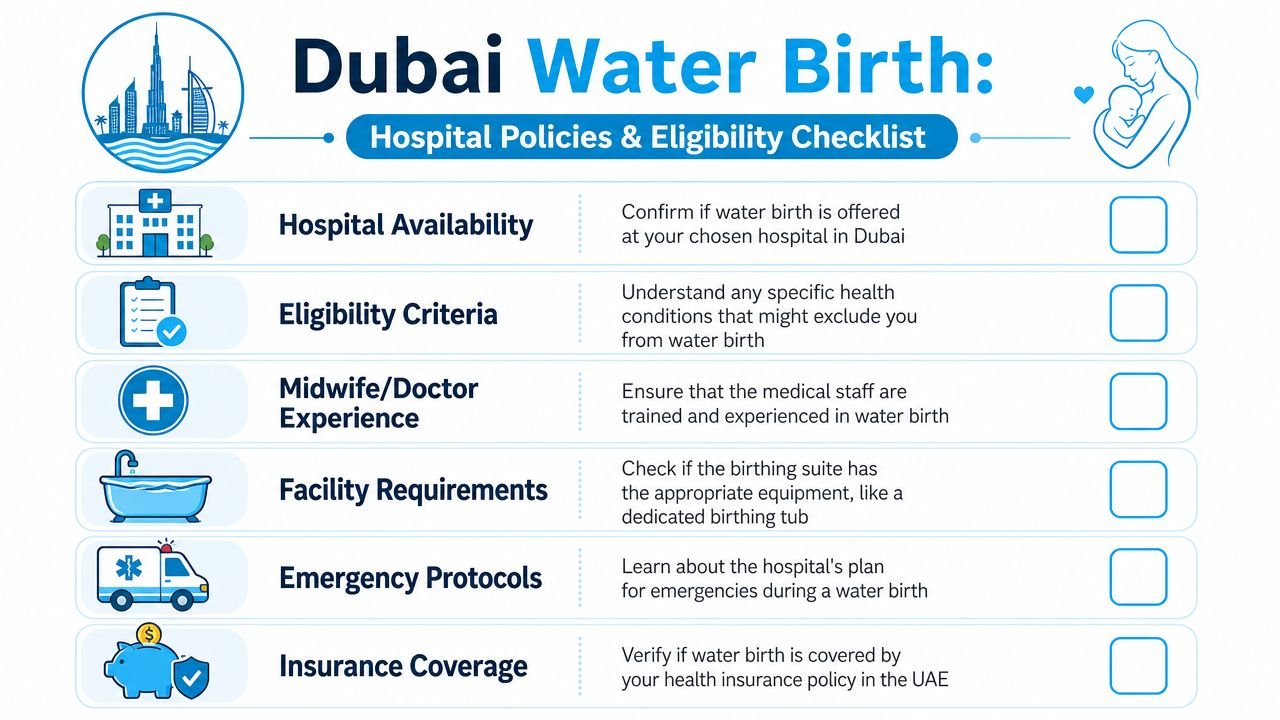
Public guidance often points to the same broad criteria for water birth: an uncomplicated pregnancy, clear amniotic fluid, a head-down baby, and labour within a typical term window, as outlined in this Dubai-focused summary of water birth eligibility.
What “eligible” usually means in practice
Eligibility is a bit like airport check-in. Buying the ticket matters, but you still need the right documents when you arrive. A water birth plan works the same way. You may look like a good candidate in the third trimester, but final approval often depends on admission findings and how labour progresses.
That is why vague reassurance can leave parents frustrated. “You should be fine” is comforting, but it is not the same as knowing the actual rules your hospital uses.
Ask your team to explain the process plainly:
- Who makes the final decision on the day? A consultant, midwife, or both?
- Is approval based only on antenatal notes, or also on admission assessment?
- Can I use the pool for labour if birth in water is no longer advised?
- Which changes would pause or end the plan? For example, meconium, monitoring concerns, or slow progress.
- If I need induction or stronger monitoring, does that rule out pool use completely?
These are the questions that save stress later. They turn “maybe” into something you can plan around.
Dubai hospitals can differ more than parents expect
Two private hospitals may both advertise water birth and still run the service differently. One may allow pool use only under a specific consultant or midwife team. Another may offer water labour more readily than actual birth in the water. A third may have limited room availability, so timing and admission status matter.
Many parents often get caught off guard. They hear “yes, we offer it,” but they do not ask, “for whom, under which doctor, and under what conditions?”
A practical way to compare hospitals is to treat the pool like one part of a bigger safety system. You are not only checking whether the tub exists. You are checking whether the staffing, monitoring, transfer routine, and documentation around it are clear.
What to confirm before you rely on the plan
Use this short comparison list in clinic or on a maternity tour:
- Service scope: Does the hospital support water labour, water birth, or both?
- Provider support: Does your own doctor or midwife actively attend these births?
- Room access: Is the pool available at all times, or only in certain rooms?
- Monitoring approach: How will staff check baby's wellbeing while you are in the water?
- Exit criteria: What specific findings would mean getting out of the pool?
- Transfer routine: If plans change quickly, how does the team move from pool to bed care?
- Written notes: Is your preference clearly recorded in your file and birth plan?
Short answers are fine, as long as they are specific.
If you are also setting up home recovery, many families in the final weeks like to sort practical basics early, including a plan for drinking water delivery and safe daily hydration in Dubai. It removes one small burden from the first days after birth.
The most helpful hospital question is often, “What would make me a strong candidate, and what would make the plan change?”
A calmer way to approach consultations
Listen for concrete explanations, not polished reassurance. A good answer sounds like, “If you arrive in active labour, baby is head down, observations are normal, and continuous monitoring is not needed, we can usually proceed.” That gives you something solid to work with.
Parents in Dubai often feel pressure to choose quickly, especially if they are balancing consultant preferences, insurance limits, and hospital packages. Slow it down. Ask for the policy in plain language. If a rule seems unclear, ask again until it makes sense.
Clarity lowers anxiety. It also helps you build a birth plan that is hopeful, flexible, and realistic.
Your Pre-Birth Planning Checklist and Key Questions
You are in a clinic room in Dubai, 34 weeks pregnant, and the conversation suddenly gets practical. Which hospital allows time in the pool? Who needs to sign off? What happens if labour starts at night, or your usual doctor is off duty? This is the stage where a hopeful idea becomes a real plan.
Pre-birth planning for water birth is a bit like packing for desert weather. You prepare for the day you want, but you also plan for a quick change in conditions. The aim is not to control every detail. The aim is to know your options well enough that surprises feel manageable.
Your planning checklist
Start with the decisions that affect whether water birth is even on the table when labour begins.
Confirm exactly what your provider supports
Some doctors are comfortable with water labour but prefer birth on land. Some midwives actively support birth in water. Ask for clear wording so you know the difference.Check the hospital process, not just the headline offering
A hospital may advertise water birth, but access can still depend on staffing, room availability, labour progress, and your clinical picture on the day.Put your preferences in writing
Include your first choice, plus your backup plan. For example, you may prefer labouring in water even if birth itself needs to happen out of the pool.Brief your birth partner properly
They need more than a general idea. They should know your priorities, your non-urgent preferences, and the questions to ask if you are concentrating through contractions.Set up your home recovery basics early
The first week usually runs more smoothly when small practical jobs are already done, including having reusable and home-ready water bottles in Dubai sorted before birth.
A short written checklist on your phone is often enough.
Questions that actually help in clinic
Broad questions often bring vague answers. Specific questions usually bring useful ones.
Try these:
- Am I currently a good candidate for water birth, based on this pregnancy so far?
- What needs to be true on the day for me to use the pool?
- Who will review that decision if I arrive in active labour?
- If the pool room is occupied, what is the backup plan?
- What are your unit's rules on eating, drinking, movement, and monitoring while I am in labour?
- If my labour slows down, what usually happens next?
- If I need induction, augmentation, or an epidural, does water labour remain an option at any stage?
- How is my birth plan shared with the team on shift?
These questions work well because they move the conversation from general preference to real-life logistics.
Why the finer details matter
Parents sometimes worry that detailed questions will sound difficult or anxious. In practice, they show good preparation. They also help you spot the difference between a team that truly offers water birth and a team that only offers it in limited situations.
For example, precise protocols around pool conditions, timing, and monitoring are a sign that the unit has thought through safety in day-to-day practice, as noted earlier. Calm care usually rests on very clear behind-the-scenes routines.
Ask for plain language. If a clinician says, “We will reassess,” follow up with, “What would you be reassessing, exactly?” That one extra question often gives you the answer you needed from the start.
Bring your questions in writing. Appointments can feel rushed, and it is easy to forget the one question that mattered most to you.
Plan for the first 24 hours too
Birth plans often get all the attention. Then you come home tired, sore, hungry, and carrying a baby who has no interest in your to-do list. Practical comfort matters here. Water by the bed, easy meals, maternity pads, feeding supplies, and help with lifting or errands all make a difference.
If you are balancing family support across Dubai, Sharjah, or Ajman, sort the basics before labour starts. That kind of preparation lowers stress for everyone in the house.
Clarity helps. So does flexibility. The strongest water birth plan is usually the one that answers two questions well: what do I hope for, and what will help me feel safe if the plan changes?
Hydration and Postpartum Care
Once the birth is over, recovery begins. This period can feel tender, blurry, and surprisingly physical. Even if the birth went well, your body has done big work. Hydration becomes one of the simplest things that can support daily comfort.
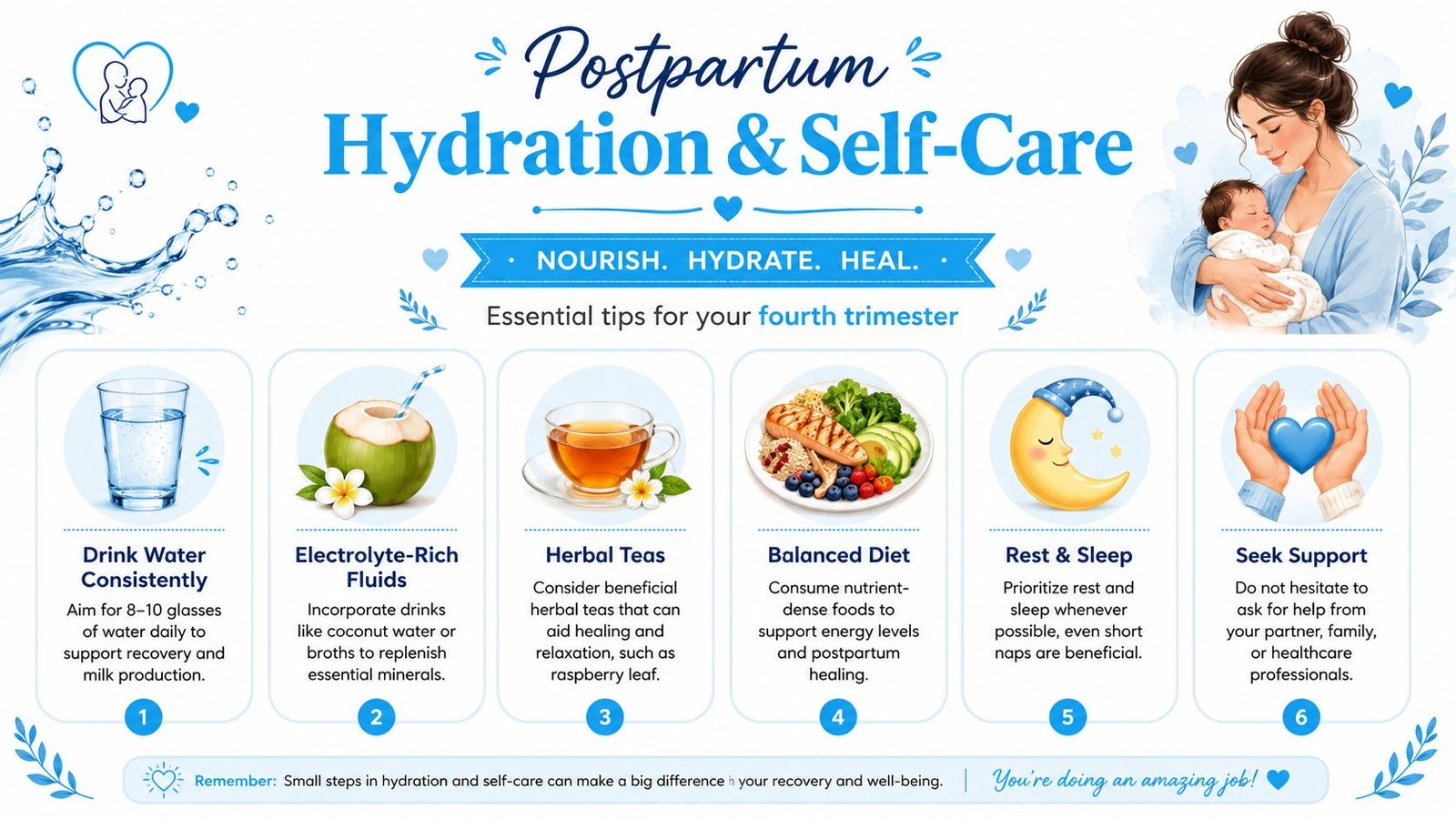
Why new parents often underestimate this
In the first days at home, you may spend long stretches feeding, sitting, recovering, or trying to rest in short bursts. That can make it oddly hard to do the basics. Drinking enough water sounds easy until you're holding a sleeping baby and realise your bottle is in the other room.
That's why planning your hydration setup matters. Keep water where you sit. Not where you think you should sit.
A simple postpartum station often includes:
- A full bottle within reach: Refill it whenever someone offers help.
- Easy snacks nearby: Hunger and thirst often arrive together.
- Backup water at home: You don't want to run out during a difficult week.
Why delivery can help after birth
Simple household support makes a difference. If you've just had a baby, carrying heavy items up stairs or from parking to home can feel miserable. Many families prefer to arrange 5-gallon drinking water in advance so one basic need is already handled.
That can be useful whether you need water delivery Dubai, water delivery Sharjah, or water delivery Ajman. It's not about luxury. It's about reducing errands when your energy is going elsewhere.
For homes and workplaces, some people also plan regular 5 gallon water delivery UAE service because routines slip easily in the newborn phase. Offices often think about hydration too, especially when supporting staff coming back from leave. A stocked office can subtly make the day easier.
Home life is different after birth
Recovery rarely follows a neat schedule. Some days you feel steady. Other days, one missed nap changes everything.
That's why reliable basics help more than people expect:
| Everyday need | Why it matters after birth |
|---|---|
| Water close by | Supports daily recovery routines |
| Less lifting | Helps when your body feels sore or tired |
| Fewer errands | Frees up time for rest and baby care |
If you're preparing your home, having a regular supply of bottled water in Dubai ready before your due date can remove one repeated task from your week.
A note for families and offices
Hydration support isn't only for the person who gave birth. Partners, visiting relatives, and older children all need easy access to water during those first busy days. In the same way, office teams do better when basics are organised before a staff member returns from maternity leave.
That's one reason drinking water delivery UAE services fit so naturally into postpartum planning. The less mental load you carry, the more energy you keep for healing, feeding, and bonding.
Your Next Step A Gentle Birth and Easy Hydration
Water birth in Dubai can be a thoughtful, supported choice when your pregnancy is suitable and your hospital team is clear about eligibility, safety, and backup plans. The key isn't chasing the perfect birth story. It's asking practical questions early and choosing care that helps you feel informed, calm, and flexible.
That same approach helps at home too. Birth planning gets most of the attention, but recovery often depends on simple things being easy. If you're preparing for life with a newborn in Dubai, Sharjah, or Ajman, sorted routines and steady hydration can make the early days feel much lighter.
Frequently Asked Questions About Water Birth in Dubai
Can my partner stay with me during a water birth?
Usually, yes, but the answer depends on the hospital and sometimes even on the labour room setup. Some units allow one support person throughout. Others limit who can be present during active labour or birth in the pool.
Ask very plainly: Can my partner stay the whole time, stand close to the pool, help me change position, and speak with staff if I am focused on contractions? Clear answers matter because support in labour works best when everyone knows their role before the day begins.
Does water birth mean I must deliver in the water?
No. Labouring in water and giving birth in water are related, but they are not the same decision.
Many women use the pool for pain relief and relaxation, then get out for the actual birth. Others remain in the pool if mother and baby continue to look well and the clinical team is happy to proceed. A good way to picture it is as one tool in your birth plan, not a contract you are locked into.
What if something changes during labour?
This is one of the smartest questions to ask in Dubai, because the practical details vary from one facility to another. If your baby's heart rate needs closer monitoring, your temperature rises, labour stalls, the water becomes unsuitable, or your doctor or midwife sees any sign that closer assessment is needed, you may be asked to leave the pool.
That is not a failure. It is normal risk management.
Before labour, ask your team what their transfer process looks like in real life. Who helps you out of the pool, how quickly can they move to a bed, what pain relief options are still available, and in what situations they would recommend a change of plan right away?
How do I know if I'm a suitable candidate?
Hospitals usually start with the same broad picture. They want a healthy pregnancy, a baby in a head-down position, and labour that is progressing in a reassuring way.
The part that often confuses parents is the phrase "low risk." On paper, it sounds simple. In an actual Dubai consultation, it can include details such as your medical history, whether your waters have been broken for a while, whether induction is involved, and whether continuous monitoring may be needed. Your own obstetrician or midwife can tell you where you fit, based on the hospital's rules rather than general internet advice.
Is water birth available outside Dubai?
Some families who live in Sharjah or Ajman still plan to give birth in Dubai because their consultant practises there or because that hospital offers the water birth setup they want. That can work well, but it needs practical planning.
Traffic, distance, and timing matter more than they seem during pregnancy. Ask yourself how long the drive takes at different times of day, when your care team wants you to come in, and whether a longer journey still makes sense if contractions become regular quite quickly.
Should I prepare my home before the birth?
Yes, especially if you want the first days after birth to feel calmer. Recovery is easier when the basics are already handled.
Set up the places you are likely to spend time feeding or resting. Keep comfortable clothes, maternity pads, baby supplies, snacks, phone chargers, and water within easy reach. If you do not want to think about errands with a newborn, having clean drinking water UAE households use every day sorted ahead of time can remove one small but annoying task.
Is it worth arranging water delivery before the baby arrives?
For many families, yes. After birth, simple jobs can feel surprisingly heavy, especially if you are healing, feeding often, and sleeping in short stretches.
Pre-arranging 5-gallon water can make the house run more smoothly in that early postpartum fog. That is particularly helpful if you want regular water delivery Ajman, water delivery Sharjah, or water delivery Dubai without heading out with a newborn.
If you'd like to make one part of newborn life easier, order your 5-gallon bottled drinking water from Oxy Plus Water through WhatsApp. They deliver to homes and businesses in Dubai, Sharjah, and Ajman, making it simple to keep your family or office hydrated with reliable doorstep service.