You've probably had this thought before. A fresh water delivery arrives at your home in Sharjah or your office in Dubai, and for a second you wonder, “How do I know this water is consistently good?”
That question is exactly where water quality monitoring comes in. It sounds technical, but the idea is simple. It means checking water in a reliable way so you can trust what you and the people around you drink every day.
For families, it's about peace of mind. For office managers, it's about making sure staff and visitors always have dependable clean drinking water UAE users can feel comfortable with.
Table of Contents
- Why Think About Your Water Quality
- Key Water Parameters Explained
- Common Ways to Check Your Water
- How to Understand Your Results
- When Should You Test Your Water
- Your Simple Plan for Clean Drinking Water
- Frequently Asked Questions
- Is water quality monitoring only for laboratories or big utilities?
- What's the most useful thing to check first?
- Are home test strips enough?
- Why does bottled water quality still need monitoring?
- Should I test every bottle I receive?
- Is this relevant for office managers?
- How do I order 5-gallon bottled drinking water in Dubai, Sharjah, or Ajman?
Why Think About Your Water Quality
If you manage a busy office, water is easy to take for granted until something feels off. If you're a parent, it often shows up as a small daily question. Does this water taste normal, look clear, and feel safe to serve?
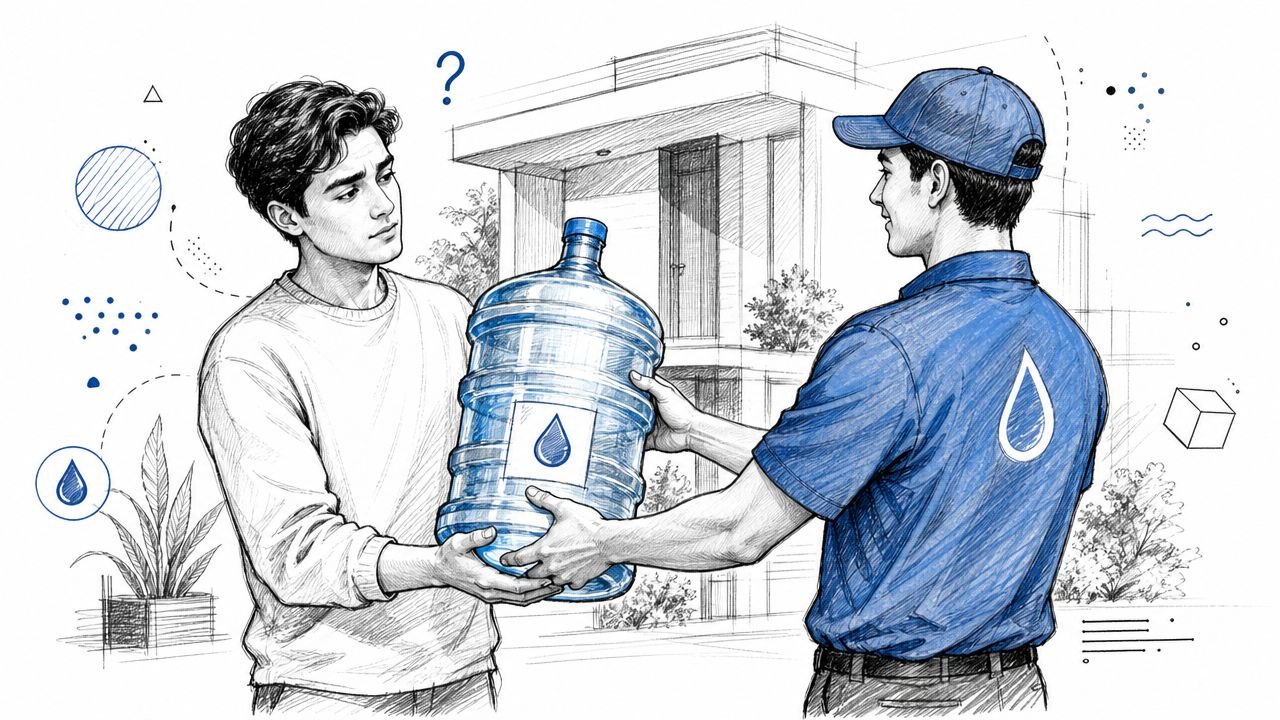
Water quality monitoring is just a structured way to answer those questions. It checks whether water stays stable and consistent, not only whether it looks fine in the moment.
That matters more now because monitoring has become a major global focus. The global water quality monitoring systems market was estimated at USD 5.67 billion in 2024 and is projected to reach USD 8.55 billion by 2030, with a 7.2% CAGR from 2025 to 2030, according to Grand View Research on the water quality monitoring systems market.
Everyday confidence matters
Water quality isn't about reading lab-style reports every week. It's about knowing that your home supply or office stock is being handled with care and checked properly before it reaches you.
In the UAE, that expectation is even more practical. Homes, schools, and workplaces need steady access to drinking water that doesn't vary from one delivery to the next.
Water quality monitoring isn't only about catching obvious problems. It's also about confirming everyday consistency.
If you're ordering 5-gallon drinking water for your flat, villa, or workplace, monitoring helps answer a basic question. Is the water staying within a reliable quality range every time you drink it?
A lot of people also mix up water quality with just taste. Taste matters, of course, but it's only one piece of the picture. A fuller understanding starts with knowing what professionals specifically check in water, especially in places like Dubai where water use and supply conditions shape daily life.
Key Water Parameters Explained
Some water terms sound more complicated than they really are. You don't need a science background to understand the basics.
Why one number is never enough
A good water check never relies on just one result. ISO monitoring practice covers a wide range of measurements, and common field programmes use a group of indicators such as pH, conductivity, turbidity, dissolved oxygen, nutrients, and bacteria, as outlined by ISO technical work on water quality measurement.
That's the important idea for you. Good water quality is a combination, not a single score.
Practical rule: If someone talks about water quality using only one number, you're not getting the full story.
A balanced water review usually looks at clarity, mineral content, chemical balance, and microbiological condition together. That's true whether you're thinking about family use at home or regular office water delivery Dubai businesses depend on.
For a quick visual explanation, this video gives a helpful overview of common water checks.
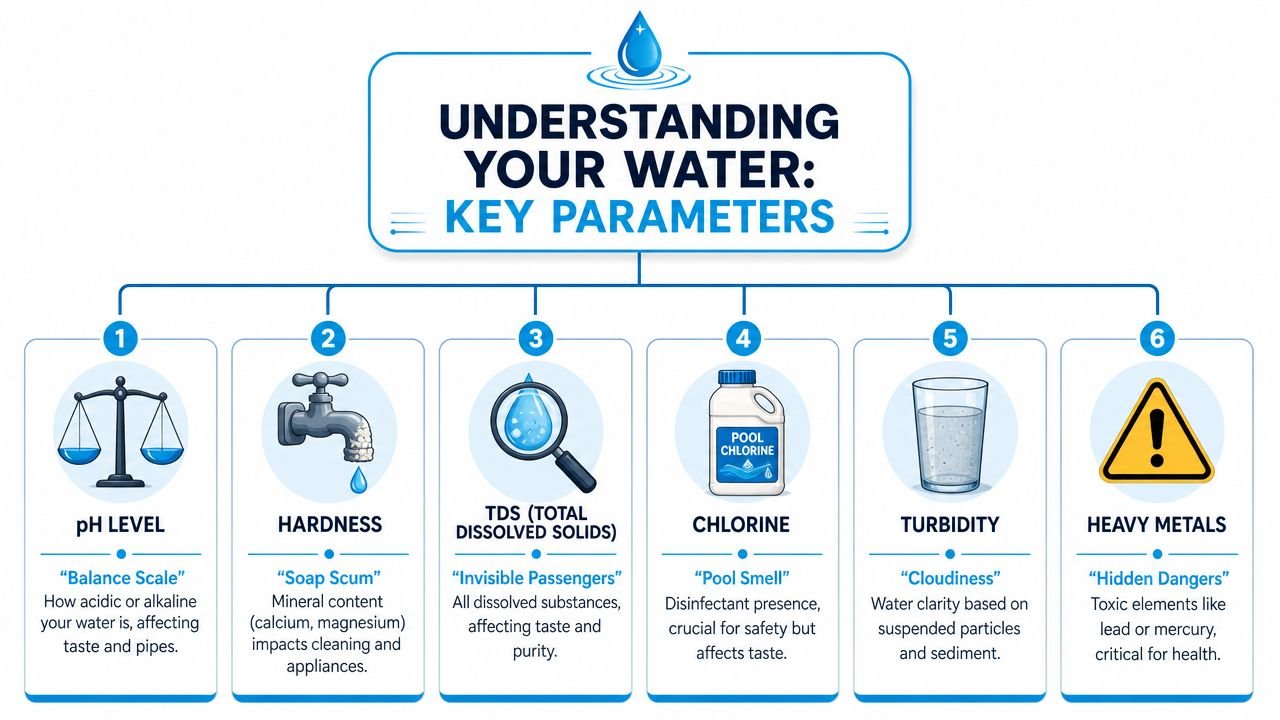
The main checks in simple words
Here are the terms that confuse people most often.
pH
This tells you whether water is more acidic or more alkaline. Think of lemon juice on one side and soap on the other. Water should stay balanced because that affects taste and overall stability. If you want a simple explanation of that idea, this guide on why pH-balanced water matters is useful.Conductivity or TDS
These point to dissolved minerals and salts in the water. A simple way to picture it is what would be left behind if the water disappeared and only the dissolved material remained.Turbidity
This means cloudiness. Clear water isn't the whole story, but turbidity is still a useful early warning sign because particles can signal handling or storage issues.Microbiological checks
These look for signs of unwanted microbial contamination. Families and offices may not see this directly, which is why professional testing matters.Chlorine
People often notice this through smell or taste. It can be part of water treatment contexts, but when people talk casually about “chemical taste”, this is often what they mean.Sodium
Some buyers pay attention to sodium because they want a lower-sodium option for everyday drinking. It's one of several quality considerations, not the only one.
A simple takeaway helps here.
| What you notice | What it may relate to |
|---|---|
| Taste seems different | pH, dissolved solids, chlorine |
| Water looks less clear | turbidity |
| One batch feels unlike the last | consistency across multiple parameters |
| You want more confidence | microbiological and professional quality checks |
Common Ways to Check Your Water
Not every water test works the same way. Some are quick and basic. Others are more dependable but need better tools or trained handling.
Quick checks at home
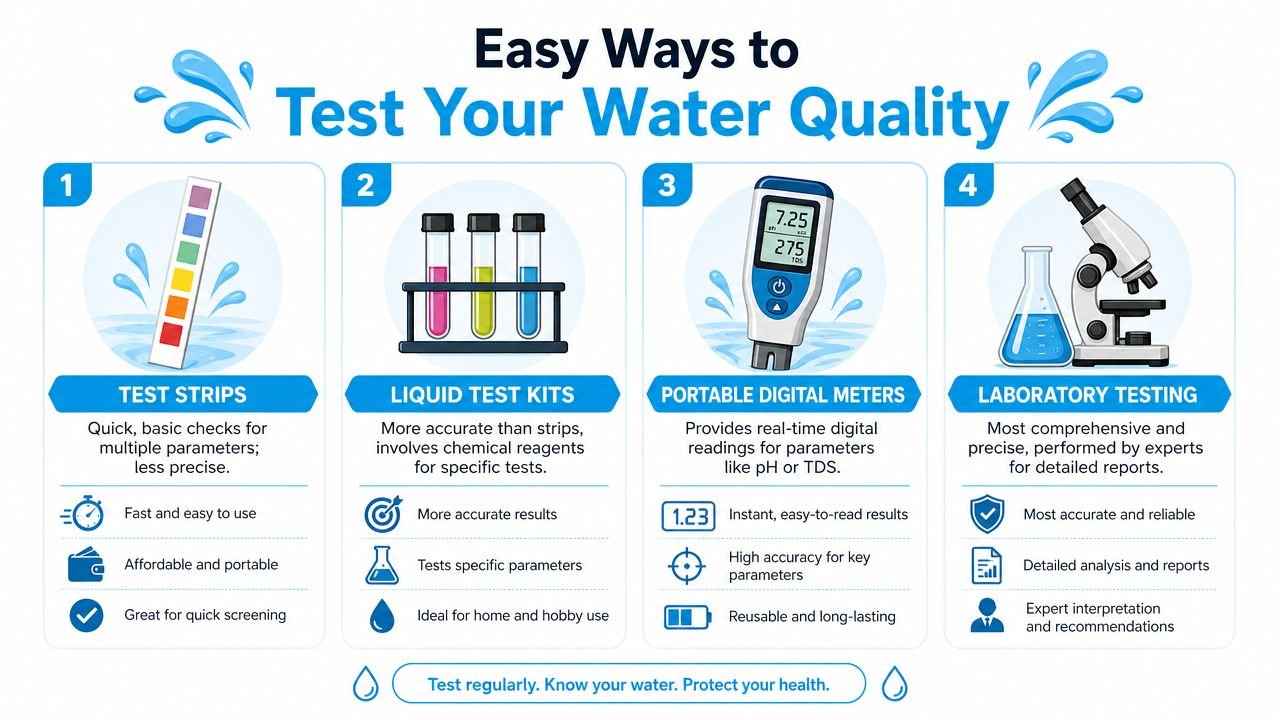
The easiest option is usually a test strip. You dip it, wait, and compare colours to a chart. That sounds simple, but there's a catch. Research shows colour interpretation can vary from one person to another, and lighting can affect what you think you're seeing, as discussed in research on improving low-cost test-strip reading accuracy.
That doesn't make strips useless. It just means they're better for a rough check than for a final answer.
A liquid test kit is one step up. It often uses drops or reagents to trigger a colour change for a specific parameter. These kits can be more deliberate than strips, but they still depend on user handling.
More reliable tools
A portable digital meter gives a direct reading for things like pH or TDS. That's usually easier to interpret because you're reading a number, not guessing between two colour shades.
A laboratory test is the most complete route when someone needs a deeper investigation. It's slower and less convenient, but it gives the strongest detail.
For families and office teams, the practical difference comes down to this:
- Test strips are fast and cheap, but interpretation can be shaky.
- Liquid kits can be more focused, but they still need careful use.
- Digital meters are easier to read for certain checks.
- Professional testing is the best option when accuracy really matters.
If you're checking water yourself, the method can affect the result almost as much as the water itself.
Water Testing Methods at a Glance
| Method | Best For | Ease of Use | Accuracy |
|---|---|---|---|
| Test Strips | Quick home checks | Very easy | Lower |
| Liquid Test Kits | Specific spot checks | Moderate | Moderate |
| Portable Digital Meters | Regular readings for selected parameters | Easy to moderate | Good for the parameter measured |
| Laboratory Testing | Detailed investigation and confirmation | Least convenient | Highest |
Consequently, many people in Ajman, Sharjah, and Dubai reach an important conclusion. Yes, you can do simple checks yourself. But if you're relying on regular drinking water delivery UAE homes and offices use every day, you usually want the testing burden handled upstream by the supplier rather than by you.
That's especially true for workplaces. An office manager already has enough to manage without turning each water delivery into a mini testing project.
How to Understand Your Results
Seeing a water result for the first time can be confusing. It's common to immediately ask, “Is this good or bad?” The better question is usually, “What does this result mean alongside the other checks?”
Look for patterns, not one isolated result
Modern water monitoring has shifted from occasional manual sampling to continuous or near-real-time measurement. The U.S. Geological Survey notes that continuous water-quality sites provide near-real-time data, and this approach helps detect short changes that occasional checks can miss, as explained by the USGS overview of water quality monitoring practice.
That matters because a single reading can be misleading on its own. Water quality is more useful when you can see whether values stay steady or drift over time.
For example, a family might notice that one bottle tastes slightly different from the previous one. An office in Dubai might find staff commenting on taste one week but not the next. In both cases, a one-off impression isn't enough. What matters is whether quality remains consistent across repeated checks.
What a family or office should pay attention to
You don't need to become a technician. You just need to know what signs deserve attention.
Clarity
If water doesn't look as clear as usual, that deserves a closer look.Taste consistency
A noticeable change in taste can point to a change in balance or handling.Smell
Drinking water shouldn't have an unexpected odour.Repeatability
If one delivery seems different from the next, consistency becomes the main question.
A useful way to read any result is to ask three things.
Was this result expected?
If not, don't jump to conclusions. Check whether the method was reliable.Does it match what I'm noticing?
If taste, look, and measured result all line up, the signal is stronger.Is this a one-time reading or part of a pattern?
Patterns tell you more than isolated readings.
A good result isn't only about a number landing in range. It's also about the water staying stable from one use to the next.
For households and businesses using water delivery Ajman, water delivery Sharjah, or water delivery Dubai, that consistency is the real standard people care about. You're not only buying water. You're relying on regular quality without having to interpret every technical detail yourself.
When Should You Test Your Water
This is the question most readers want answered. Do you need to test your water regularly at home or in the office?
Most people don't need frequent self-testing
If you're using a trusted supplier for 5-gallon water, regular self-testing usually isn't necessary. Most families don't need to check every delivery. Most office managers don't need to build a routine around strips, kits, or meters.
That's because the smarter choice is usually to rely on a provider that already treats monitoring as part of the job. For everyday use, confidence comes more from choosing well than from constantly checking after delivery.
This is especially true for busy settings. A small office in Sharjah, a clinic in Ajman, or a household in Dubai needs dependable water without adding another maintenance task to the week.
Times when a simple check makes sense
There are still a few situations where a basic check can help.
You're trying a new supplier
If you don't yet know how reliable they are, a simple test may give added reassurance.The water seems different
If taste, smell, or appearance changes suddenly, it's reasonable to pause and investigate.Storage may have been poor
If bottles were left in unsuitable conditions, caution makes sense.You need peace of mind
Sometimes the main value of a simple test is reassurance, not diagnosis.
The key is not to overcomplicate it. Self-testing can be useful as a backup step, but it shouldn't replace choosing a dependable source of 5 gallon water delivery UAE customers can trust for routine home or workplace use.
The best plan is often simple: use a reliable bottled water service. Store bottles properly. Pay attention if something seems unusual.
Your Simple Plan for Clean Drinking Water
You don't need to become an expert in water chemistry to make smart choices. You just need to understand that water quality monitoring is about consistency, clarity, balance, and trust.

For homes and offices, the easiest plan is practical.
- Choose a supplier that takes quality seriously
- Store bottles properly
- Notice changes in taste, smell, or clarity
- Keep ordering simple and regular
If you're comparing providers, it also helps to understand why quality certification matters when choosing a purified water manufacturer. That gives you a better way to judge reliability than guesswork alone.
Frequently Asked Questions
Is water quality monitoring only for laboratories or big utilities?
No. The term sounds large-scale, but the idea is simple. It means checking water quality in a consistent way so families, offices, and facilities can trust what they're drinking.
What's the most useful thing to check first?
For everyday users, the most practical first signs are clarity, taste, smell, and consistency from one delivery to the next. In formal testing, professionals look at multiple indicators together rather than relying on one result alone.
Are home test strips enough?
They can be useful for a quick check, but they have limits. Colour-based results can depend on lighting and user interpretation, so they're best treated as rough indicators rather than final proof.
Why does bottled water quality still need monitoring?
Because bottled water should be consistent, not just acceptable once. Families and offices want the same dependable quality each time they open a bottle, whether they're arranging water delivery Sharjah homes rely on or larger office deliveries in Dubai.
Should I test every bottle I receive?
Usually no. If you use a reliable service, frequent self-testing isn't necessary for most households or offices. It's more sensible to choose a supplier with clear quality standards and stable delivery habits.
Is this relevant for office managers?
Very much so. Offices need water that stays dependable for staff and visitors, and that's why office water delivery Dubai companies often prefer a supplier that handles quality control before delivery rather than leaving checks to the workplace.
How do I order 5-gallon bottled drinking water in Dubai, Sharjah, or Ajman?
The simplest option is to contact the supplier directly on WhatsApp and arrange a regular or one-time delivery schedule that fits your home or office needs.
If you want reliable 5-gallon bottled purified drinking water for your home or office in Dubai, Sharjah, or Ajman, contact Oxy Plus Water on WhatsApp through the website and place your order today.