You've probably asked this already if you're new to the city, managing a family home, or running an office team in Dubai. You turn on the tap, fill a glass, pause for a second, and wonder if the water is fine to drink.
That question comes up just as often in Sharjah and Ajman too. People hear that Dubai has modern water infrastructure, but they also hear stories about tank cleaning, strange taste, or neighbours who only trust bottled water.
Understanding water quality in Dubai is straightforward once examined closely. It is not just about where the water starts. It's also about what happens on the way to your kitchen, pantry, or office break room.
If you're choosing between tap water and a reliable 5-gallon drinking water delivery, it helps to understand the full journey first.
Table of Contents
- Is the Water in Dubai Safe to Drink
- Where Dubai's Water Comes From
- How Water Quality Is Regulated and Tested
- Tap Water vs Certified Bottled Water
- Choosing a Reliable Water Delivery Service
- Your Simple Solution for Clean Drinking Water
- Frequently Asked Questions About Water in Dubai
- Is Dubai tap water safe for cooking
- Why does tap water sometimes taste different from one building to another
- Why do many people still buy bottled water if municipal water is treated
- Is bottled water a practical choice for offices
- Do people in Sharjah and Ajman have the same concerns
- What does 5 gallon water delivery UAE service usually suit best
- How should I choose a drinking water supplier
- Does Oxy Plus Water sell anything besides bottled water delivery
- Can I order by WhatsApp instead of calling
- Which keywords should I actually care about when searching online
Is the Water in Dubai Safe to Drink
You move into a new apartment in Dubai, fill a glass from the kitchen tap, and pause for a second. The question is not only whether the city treats water properly. Rather, the question is what happens between the public network and your cup.
That distinction explains why this topic feels confusing to so many people.
Dubai's municipal water supply is treated and monitored. But daily drinking water quality is also shaped by the last mile inside buildings, including storage tanks, internal pipework, and maintenance standards. For families, that affects taste, smell, and confidence. For office managers, it affects whether staff reach for the dispenser, complain about the tap, or avoid it altogether.
Why people get confused
People often use one short question to mean two separate things.
First, they want to know whether the city supply is safe at the point it enters the distribution system. Second, they want to know whether the water coming from a tap in their flat, villa, or office pantry feels clean and reliable every day.
Those are different stages of the same journey.
A simple comparison helps. Bread can leave the bakery fresh, then lose quality if it is stored badly before it reaches your table. Water works in a similar way. Treatment at the city level matters a lot, but storage and handling inside a building shape the final experience.
The answer most residents need
For the municipal supply, there are good reasons for confidence. For the water people drink at home or at work, the answer depends on the condition of the building as well.
That is why families and office teams often separate two ideas. One is system safety. The other is everyday trust.
A parent may care less about technical compliance and more about whether the drinking water tastes consistent enough for children to accept without fuss. An office manager usually thinks in practical terms too. If pantry water has an odd taste, if the tank cleaning schedule is unclear, or if staff keep asking for an alternative, certified bottled water starts to feel like the simpler choice.
This is the heart of the issue in Dubai. The city can do its part, and residents can still prefer a controlled drinking option because the last mile happens inside individual buildings, not inside the treatment plant.
If you have ever felt unsure about drinking straight from the tap in a home or office here, that reaction is understandable. You are not questioning the whole system. You are asking whether the final part of the journey is as reliable as the first.
Where Dubai's Water Comes From
You turn on the kitchen tap in Dubai, fill a glass, and the water in front of you has already completed a long industrial journey before it ever reaches your building.
In this city, drinking water mainly starts as seawater. That surprises many new residents, but it explains a lot about how Dubai's water system works and why people often separate the source of the water from what finally comes out of a tap at home or in the office.
Desalination is the main reason that is possible. In simple terms, desalination removes salt from seawater so the water can be used for drinking, cooking, washing, and other daily needs.
A kettle offers a useful comparison. When water turns to steam, the salt does not rise with it. Large desalination plants use far more advanced equipment, but the basic principle is similar. The system takes in seawater, removes salt and unwanted substances, then prepares the water for distribution across the city.
A quick visual makes that journey easier to understand.
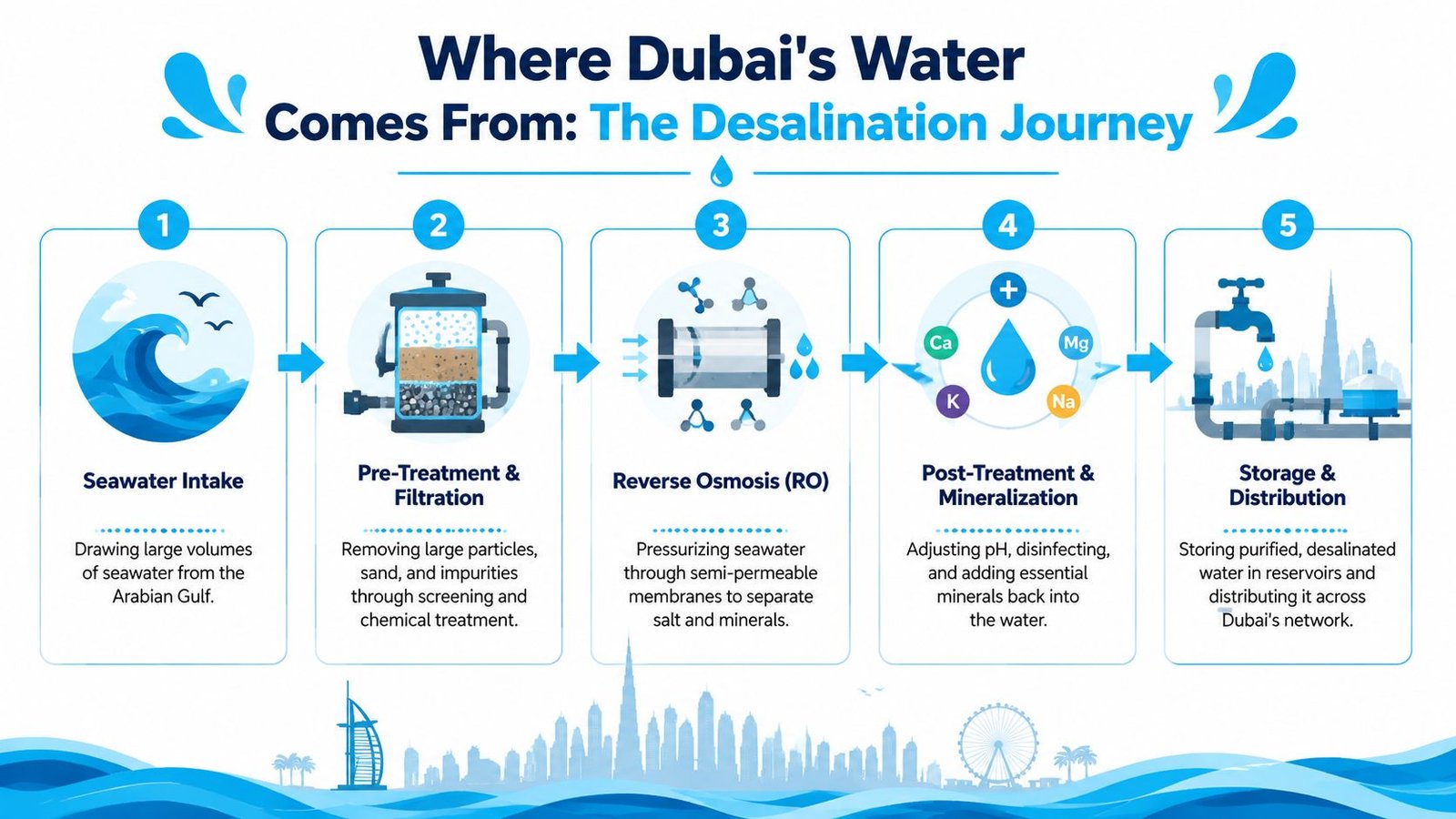
Why desalination matters so much
Dubai has very limited natural freshwater compared with wetter countries. That is why the water system depends on engineered production, careful treatment, and close control from source to distribution.
For residents, that means the starting point is usually not a mountain reservoir or river. It is a treatment process built to convert seawater into usable water at scale. For office managers, the same point matters for a different reason. Supply reliability depends heavily on infrastructure, operating standards, and ongoing water quality monitoring practices, not on a nearby natural freshwater source.
That background helps explain an important local habit. People may feel comfortable with the city-level supply and still prefer certified bottled water for drinking. The reason often has less to do with where the water began and more to do with what happens after it leaves the plant.
For a closer look at the process, this short video gives useful background.
What that means for daily life
For a family, desalination means the water entering the building has usually gone through heavy treatment before it reaches the neighborhood network. For an office, it means pantry water starts as part of a centralized system designed for a large urban population.
The practical question begins after that point.
Water still has to pass through pipes, storage tanks, pumps, and internal plumbing before someone drinks it. That final stretch is what people experience. If a building is well maintained, confidence is easier to keep. If tank cleaning is irregular or internal plumbing is aging, trust drops fast, even when the original source was treated properly.
That is why the story of water quality in Dubai is not only about desalination. It is also about the last mile inside buildings, where city-scale engineering meets everyday life.
How Water Quality Is Regulated and Tested
A lot of confusion starts with the phrase “treated water.” It can sound like water is cleaned once, approved once, and then forgotten. Dubai's system does not work that way. Water quality is checked against defined health and quality standards, and the rules cover microbiological safety, chemical limits, and how water should look and taste in normal use.
One clear example is the standard for Total Coliforms. Dubai Municipality applies a zero-tolerance limit of 0 CFU/100 mL, with reporting and corrective action requirements tied to any result outside that standard, as outlined in this overview of Dubai water quality standards.
That matters because coliform testing works like an early warning light on a car dashboard. It does not describe every possible problem on its own, but it helps show whether the water system is staying within safe microbiological conditions.
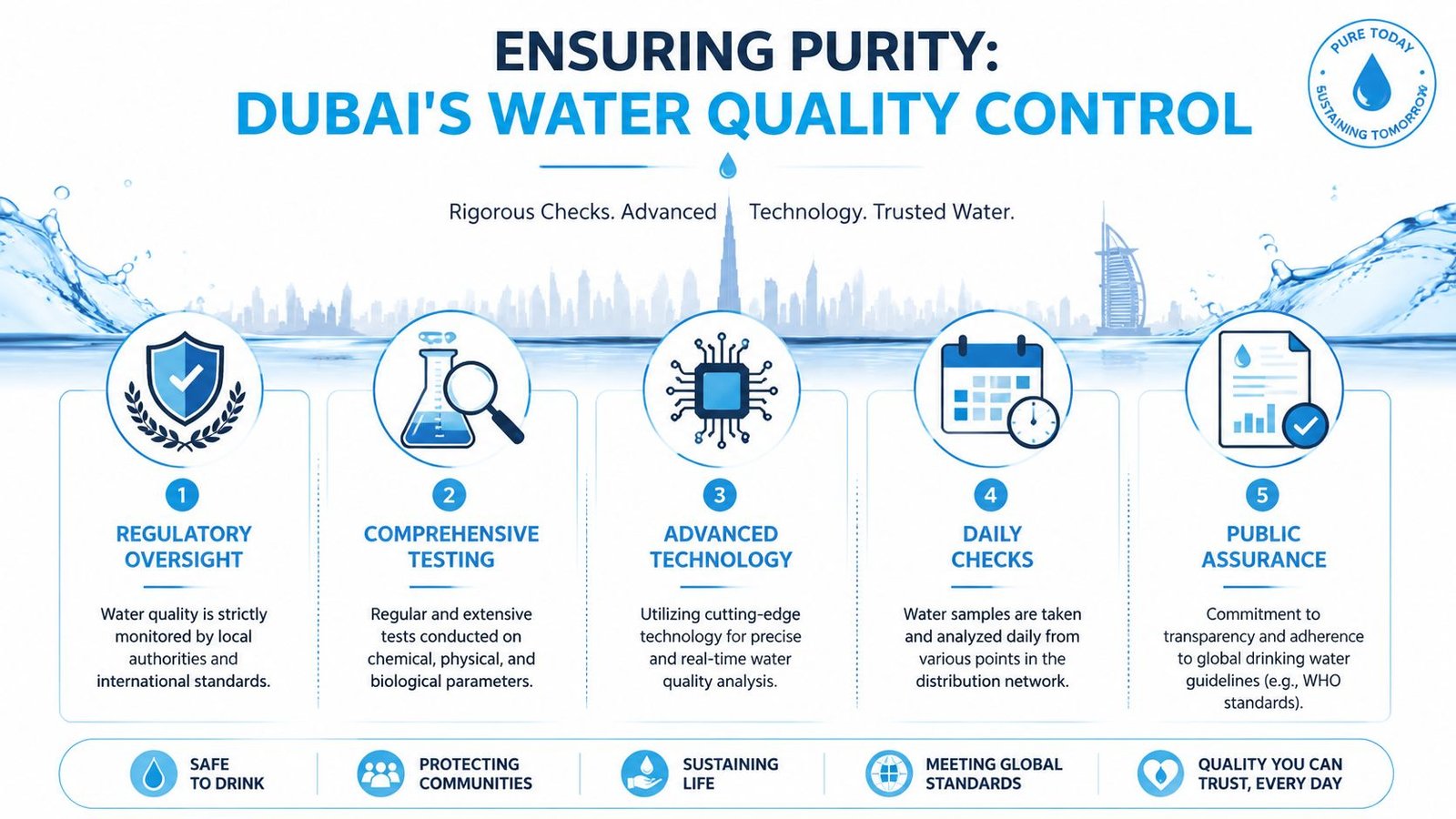
What the rules check
Some of the technical language becomes much easier once you connect each term to a real-life concern at home or in the office.
- Microbiological safety: Total Coliforms must be 0 CFU/100 mL. In plain language, this indicator should not be present in drinking water.
- Clarity: Turbidity must stay below 1 NTU for 95% of samples. That means the water should stay very clear, with low levels of suspended particles.
- Chemical limits: Nitrates are limited to under 50 mg/L and lead to under 0.01 mg/L.
- Disinfection balance: Residual chlorine is maintained between 0.2 and 0.5 mg/L. The goal is to keep protection in the water while avoiding a stronger-than-necessary chlorine taste.
- Emerging contaminants: The same standards overview lists a PFAS limit of under 0.0001 mg/L effective from 2026.
If you want a broader explanation of routine checks across the supply chain, Oxy Plus has a useful page on water quality monitoring in Dubai.
Why these rules matter in daily life
Each limit connects to something people notice.
Microbiological standards relate to health. Turbidity affects whether water looks clean in a glass. Chlorine levels can shape taste and smell. Chemical limits matter even when the water looks perfectly fine, because some risks are not visible.
For a parent making juice or baby formula, those standards provide reassurance about the regulated supply entering the area. For an office manager filling pantry kettles and coffee machines, they show that city-level water is controlled through testing rather than assumption.
But regulation is only part of the story. These standards describe the supply system up to the point it reaches the building. After that, the last mile begins. Storage tanks, pumps, and internal pipes can affect the water people end up drinking, which is one reason many homes and offices still choose certified bottled water for daily use.
Tap Water vs Certified Bottled Water
This is the part cared about most. Not the treatment plant. The glass in your hand.
In Gulf conditions, expert analysis points to a real gap between central supply quality and point-of-consumption conditions. Heat and building storage can affect water, which helps explain why many residents in Dubai, Sharjah, and Ajman prefer bottled water for consistency, according to this Gulf Research Center commentary on household water quality conditions.
The last mile problem inside buildings
Think of the city supply like a clean parcel arriving at your building entrance. After that, the last stretch still matters.
Water may pass through storage tanks, internal plumbing, and hotter building conditions before you drink it. Even when the source water is produced to high standards, taste, smell, and confidence can shift at the last mile.
That's why two flats in the same area can have different drinking experiences. It's also why one office pantry gets constant complaints while another feels perfectly fine.
For many families, this shows up as uncertainty. For office teams, it shows up as staff asking for bottled water instead of using the tap.
If you want a closer look at why many households choose bottled supply, this page on bottled water in the UAE is relevant.
Comparing Your Water Options
The decision often comes down to what you value most. Source confidence, daily taste, convenience, and control all matter.
| Factor | Tap Water | Certified Bottled Water |
|---|---|---|
| Source quality | Produced within a regulated municipal system | Prepared and packed as drinking water for direct use |
| What affects it after production | Building tanks, internal pipes, heat, and storage conditions may influence the final experience | Bypasses most building water-path issues before drinking |
| Taste consistency | Can vary from one building to another | Usually chosen for more predictable taste |
| Best fit for home use | Fine for many household uses such as washing and cooking | Often preferred for direct drinking |
| Best fit for offices | May lead to mixed staff opinions depending on the building | Easier to standardise for team drinking needs |
| Practical convenience | Always available from the tap | Requires scheduled supply from a reliable provider |
Key takeaway: The question isn't only “Is tap water treated well?” It's also “What happens after it enters my building?”
That difference explains a lot about local behaviour. People in water delivery Dubai, water delivery Sharjah, and water delivery Ajman markets often aren't rejecting city infrastructure. They're choosing a more predictable final drinking experience.
For homes, that often means 5-gallon water for the kitchen or dining area. For offices, it means keeping a steady stock so staff don't keep asking whether the tap tastes odd today.
Choosing a Reliable Water Delivery Service
A common Dubai routine goes like this. The water cooler is empty at 10:30 a.m., the office group chat starts buzzing, and someone asks who forgot to reorder. At home, the version is simpler but just as annoying. You reach for a glass at dinner and realise the spare bottle is already finished.
That is why choosing a supplier is not only about the water itself. It is about whether daily drinking stays easy, predictable, and low-stress inside your building.
What to check before you order
Start with the last mile. In water service, the last mile means the part you deal with directly: ordering, delivery timing, bottle condition, and whether fresh drinking water is there when people need it. A supplier can sound fine on paper and still create daily friction if deliveries are late or communication is unclear.
A few checks make the choice easier:
- Quality credentials: The supplier should clearly show that it operates within the UAE's regulated drinking water system.
- Delivery coverage: If your home, staff, or branches are spread across Dubai, Sharjah, and Ajman, confirm the service area before you commit.
- Simple ordering: WhatsApp reordering is useful because it cuts out phone-tag and saves time during a busy day.
- Consistency: Look for a provider that delivers on schedule and replies clearly when you need a refill or update.
If you want a starting point, this guide to drinking water suppliers in Dubai can help you compare providers.
What works well for homes and offices
Homes and offices ask for different kinds of reliability.
For a family, the main question is usually, "Will we run out?" Parents want enough 5-gallon water on hand, easy repeat ordering, and delivery times that fit around work, school, and weekends. The best service feels a bit like a pantry refill. Quiet, regular, and easy to manage.
For an office manager, the question is broader. You are not only stocking water. You are preventing small interruptions that staff notice right away. If the cooler runs dry, people stop what they are doing, ask around, and wait for someone else to fix it. A reliable supplier removes that background hassle.
Use a practical checklist:
- For families: Choose a service with regular 5-gallon bottle delivery and a simple way to reorder fast.
- For offices: Choose a supplier that can support recurring deliveries without constant follow-up.
- For multi-location needs: Confirm that the company serves Dubai, Sharjah, and Ajman if your household or business moves between cities.
Oxy Plus Water is one option in this category. It focuses only on 5-gallon bottled purified drinking water for homes and businesses in Dubai, Sharjah, and Ajman, with ordering available through WhatsApp.
That kind of narrow focus can be helpful. It keeps the service clear. You know what the company handles, and the decision stays simple.
Your Simple Solution for Clean Drinking Water
By the time water reaches your glass, the main question isn't only how it was produced. It's whether the final drinking experience feels clean, reliable, and easy to manage in your actual building.
That's why so many families and office managers choose 5-gallon drinking water instead of relying only on the tap. It gives you a more controlled and predictable option for daily drinking, especially when taste consistency matters.
If you need water delivery Dubai, water delivery Sharjah, or water delivery Ajman service for your home or office, keep it simple. Choose a supplier that focuses on bottled drinking water, offers clear communication, and lets you order on WhatsApp without wasting time.
Frequently Asked Questions About Water in Dubai
Is Dubai tap water safe for cooking
In many homes, tap water is used for cooking, washing produce, and making tea or coffee. The bigger question usually starts at the drinking stage, after the water has passed through rooftop tanks, internal pipes, and taps inside the building.
Why does tap water sometimes taste different from one building to another
Dubai's water supply is treated before it reaches buildings. The taste can still change on the last part of the journey. Building tank condition, pipe age, cleaning schedules, and heat all affect what reaches your glass, much like clean air can still pick up dust as it moves through an old AC duct.
Why do many people still buy bottled water if municipal water is treated
Many residents want a drinking option that feels more predictable day after day. For families, that means less second-guessing at home. For office managers, it means fewer comments about taste, smell, or whether the pantry water is “fine today.”
Is bottled water a practical choice for offices
Yes. It gives everyone one clear drinking source, which makes refilling, budgeting, and daily use easier to manage.
Do people in Sharjah and Ajman have the same concerns
Yes. The same last-mile question comes up across all three emirates. Residents want to know what happens after treated water enters the building, because that final stretch often shapes trust more than the original source does.
What does 5 gallon water delivery UAE service usually suit best
It works well for homes that want a steady supply for direct drinking and for offices that need a simple routine. Many people use tap water for cleaning and cooking, then keep bottled water for the water they drink most often.
How should I choose a drinking water supplier
Start with the basics. Check certifications, delivery reliability, coverage in your area, and how easy it is to place a repeat order. A supplier should make routine delivery feel straightforward, especially if you are ordering for a busy home or an office pantry.
Does Oxy Plus Water sell anything besides bottled water delivery
No. Oxy Plus Water focuses on 5-gallon bottled purified drinking water delivery for homes and businesses in Dubai, Sharjah, and Ajman.
Can I order by WhatsApp instead of calling
Yes. That is often the easiest option for quick reorders, especially if you are managing household supplies or coordinating office deliveries between meetings.
Which keywords should I actually care about when searching online
Search terms should match the job you need done. Home users often look for clean drinking water UAE or 5 gallon water delivery UAE. Office teams are more likely to find useful results with drinking water delivery UAE or office water delivery Dubai.
Need a simple, reliable way to keep drinking water stocked at home or work? You can order Oxy Plus Water by WhatsApp for 5-gallon delivery in Dubai, Sharjah, and Ajman.