You're probably doing one of two things right now. You're filling glasses at home in Dubai or Ajman and wondering what's in your water, or you're the person at work in Sharjah who has to make sure everyone has a reliable, safe supply every day.
That question is reasonable. Water gets talked about as if it's either “safe” or “unsafe”, but real life is a bit more nuanced than that.
Some water meets municipal standards for daily use. Some bottled options meet even tighter standards for purity. If you understand the basic rules, you can make a calmer, smarter choice for your family or your workplace.
Table of Contents
- Why Thinking About Your Water Matters
- What Are Drinking Water Quality Standards
- Your Guide to Reading a Water Report
- Purified Bottled Water vs Tap Water Standards
- The Importance of Low-Sodium Water for Your Diet
- How to Choose a Reliable Water Delivery Supplier
- Get Clean, Low-Sodium Water Delivered Today
- Frequently Asked Questions
- Is tap water in the UAE safe to drink
- What does TDS mean on a water label or report
- Why do people choose 5-gallon water instead of regular tap water
- Does low-sodium water really matter
- How can I tell if a water delivery supplier is reliable
- Is bottled water always better than tap water
- What should office managers look for first
Why Thinking About Your Water Matters
A parent in Dubai making baby formula doesn't want to guess. An office manager arranging water delivery Dubai for a team doesn't want vague promises either.
You want clarity. You want to know what “good water” means and whether the bottle or supply you choose matches your daily needs.
At home, water is part of every routine. You drink it, cook with it, and offer it to guests without thinking much about it until a label, a report, or a news story makes you pause.
In an office, the same question shows up differently. You're responsible for staff comfort, pantry planning, and basic trust in what people drink during the day.
Good decisions about water usually start with simple questions, not technical expertise.
There's also a common point of confusion in the UAE. Many people hear that tap water is regulated, then assume every kind of drinking water follows the exact same quality target.
It doesn't. Municipal water and 5-gallon drinking water can be held to different standards, and that matters if you care about purity, sodium level, taste, or consistency.
Everyday situations where standards matter
- For families: You may want clean drinking water UAE households can rely on every day, especially if someone in your home pays attention to sodium intake.
- For offices: You may need office water delivery Dubai teams can depend on without chasing late deliveries or unclear quality information.
- For shared buildings: Storage, handling, and testing matter because water quality isn't only about the source. It's also about what happens before you drink it.
Once you know how standards work, the topic gets much less intimidating. You stop relying on guesswork and start reading water information with confidence.
What Are Drinking Water Quality Standards
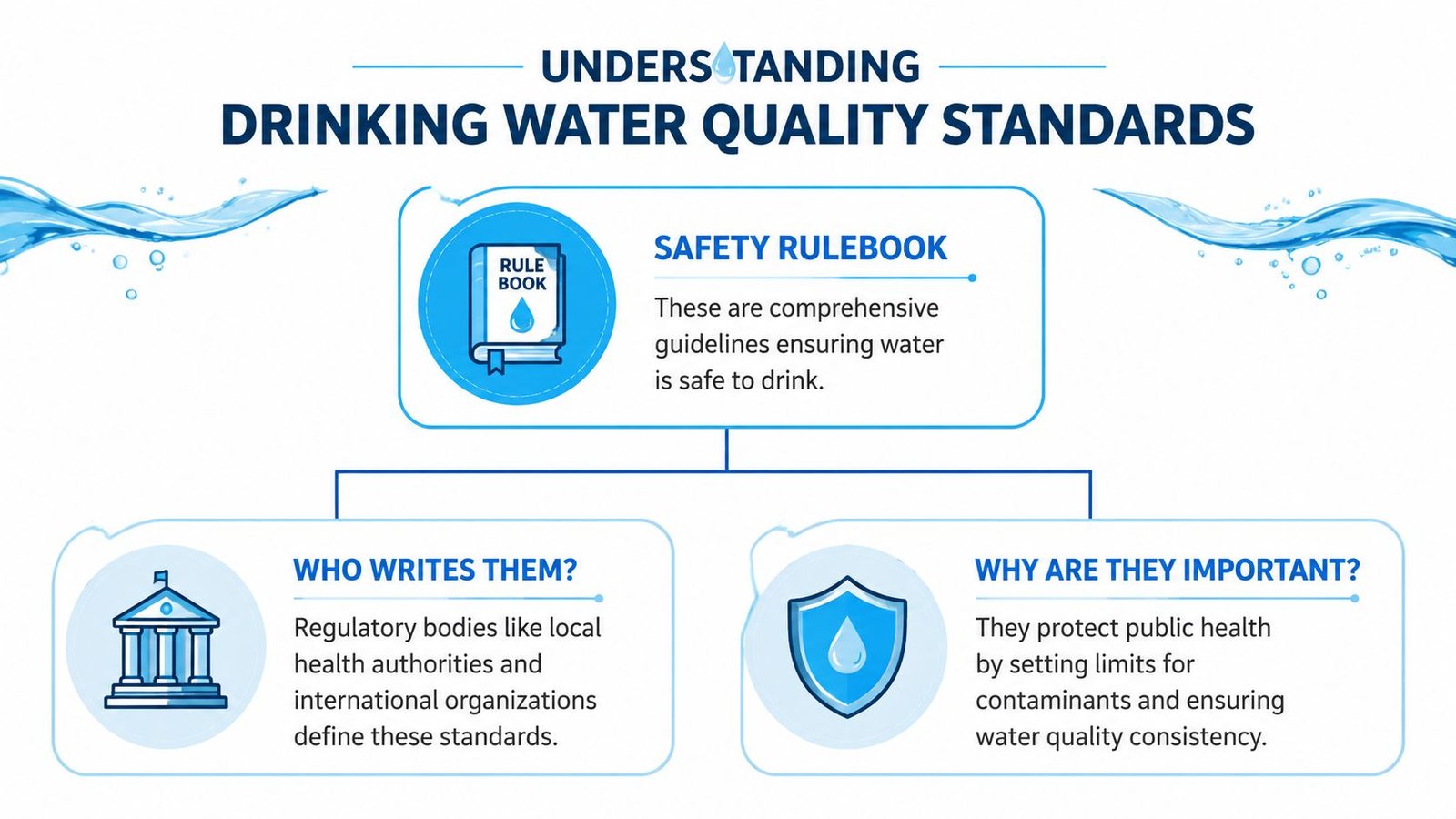
Drinking water quality standards are the rulebook for what's allowed in water and what isn't. They set safety limits, testing requirements, and hygiene expectations so the water reaching you is suitable to drink.
That sounds technical, but the idea is simple. Regulators define what must be checked, how often it must be checked, and what happens if a result goes outside the limit.
Who sets the rules
Some standards align with global public health guidance, including World Health Organisation benchmarks. In the UAE, local authorities then apply and enforce those rules in a practical way for homes, buildings, and businesses.
That local part matters. It's what turns a general safety principle into actual testing schedules, reporting duties, and compliance checks in places like Dubai, Sharjah, and Ajman.
A clear example appears in the UAE 2025 Water Quality Regulations, which set lead at 0.01 mg/L, arsenic at 10 μg/L, and total coliforms at 0 CFU/100 mL for drinking water supplied to homes and businesses.
What these standards try to prevent
The standards focus on a few broad risk areas:
- Heavy metals: Limits are set for substances like lead and arsenic because they shouldn't exceed defined safe levels.
- Microbiological contamination: Organisms such as total coliforms and E. coli are watched closely because they can signal contamination.
- Operational quality: Things like pH, chlorine, turbidity, and temperature help keep water stable, clear, and suitable for drinking.
Practical rule: Standards don't exist to make reports look official. They exist so problems can be found early and corrected quickly.
The UAE rules also show that standards aren't only about the number itself. They include action requirements. If water quality exceeds limits, operators are expected to notify authorities and follow up with corrective steps.
Why this matters to you
If you're a family ordering drinking water delivery UAE services, standards help you ask better questions. If you manage a workplace, they help you separate a reliable supplier from one that only sounds reassuring.
This also explains why not all water choices are equal. Two options can both be “drinking water” while following different purity thresholds depending on whether they are municipal supply or bottled water made under bottled water standards.
That difference is where many people get stuck. The next step is learning how to read the common terms on a report without feeling like you need a lab background.
Your Guide to Reading a Water Report
A water report can look more complicated than it really is. Most people only need to understand a few terms to make sense of what they're seeing.
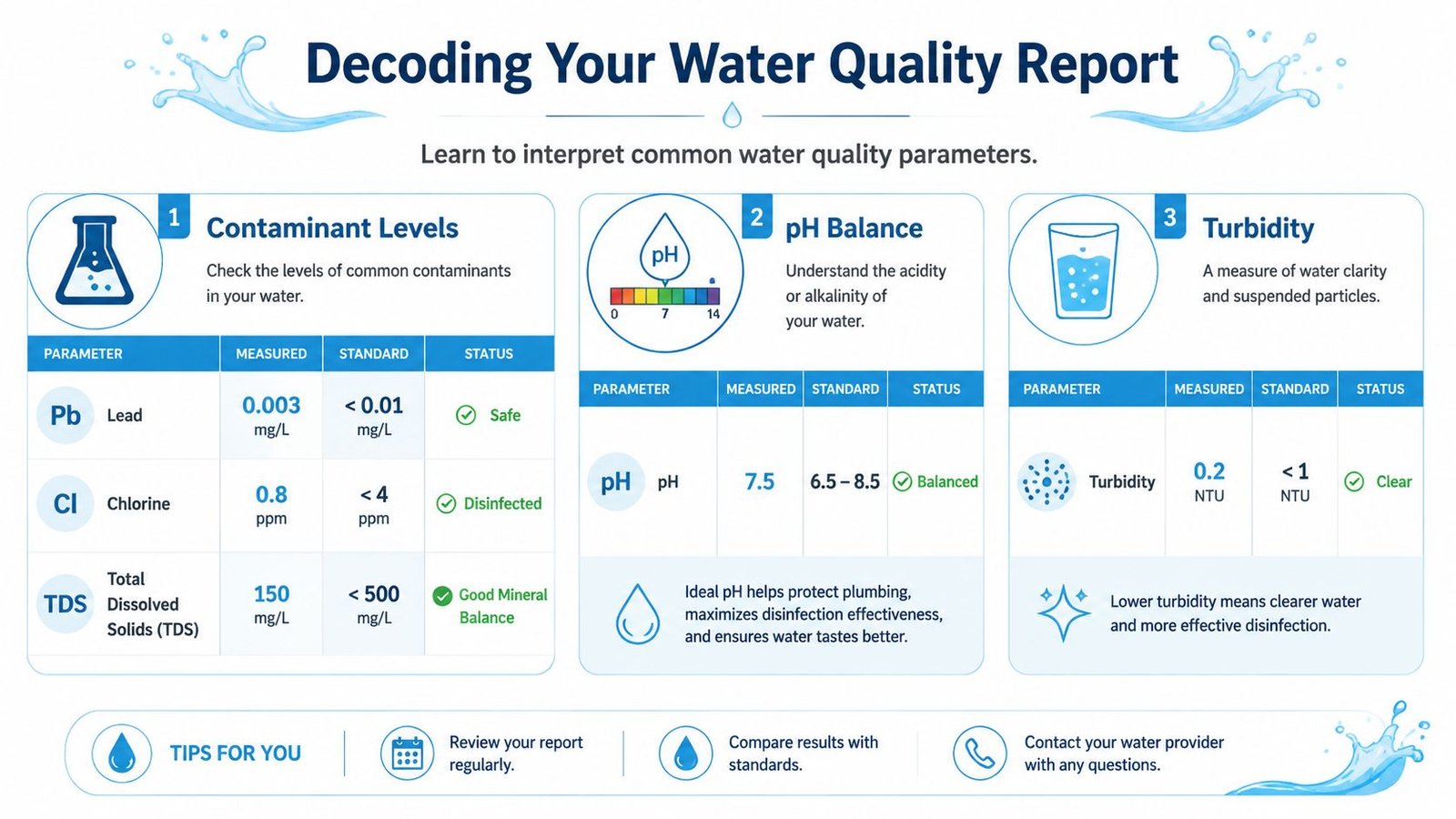
Start with the basics. Look for microbiological safety, pH, TDS, and sodium if they're listed.
Microbiological safety
This is the most important part to understand first. You want the report to show that harmful indicator organisms are absent.
The clearest example is in UAE drinking water microbiological standards, which require E. coli to be completely absent in 100 mL samples and set total coliforms at 0 CFU/100 mL.
If you're checking supplier information, this is the kind of result that tells you the water is being monitored for contamination risk, not just taste or appearance.
pH and what it tells you
pH tells you whether water is more acidic or more alkaline. For most readers, the practical meaning is simple. It can affect taste, balance, and how the water feels to drink.
For bottled drinking water, the pH range is often shown because it's an easy number to understand on a report or label. A value inside the accepted range suggests the water sits within the standard set for that product category.
TDS in plain language
TDS means Total Dissolved Solids. It refers to the dissolved substances in water.
People often get confused here because lower TDS doesn't automatically mean “better” in every context. What it does mean is that you can use TDS as one indicator of how pure the water is compared with the standard for that type of water.
For a closer look at how ongoing checks support consistency, you can read about water quality monitoring.
Here's a simple way to read common report terms:
| Report term | What it means to you |
|---|---|
| E. coli / coliforms | Shows whether contamination indicators are present |
| pH | Gives you a sense of balance and drinking comfort |
| TDS | Helps you compare purity levels between water types |
| Sodium | Useful if your household or team watches sodium intake |
Sodium deserves a closer look
Sodium isn't always the first thing people check, but many should. If someone in your home or office is trying to manage dietary sodium, it becomes a very practical number.
Don't read a water report like an exam paper. Read it like a label that helps you make one clear decision.
If a report feels crowded, keep your focus narrow. First, confirm microbiological safety. Then look at TDS and sodium. After that, pH can help you understand overall balance.
A short video can also make these terms easier to follow before you compare products or delivery options.
That's enough to read most water information with confidence. You don't need to memorise lab language. You just need to know what to look for.
Purified Bottled Water vs Tap Water Standards
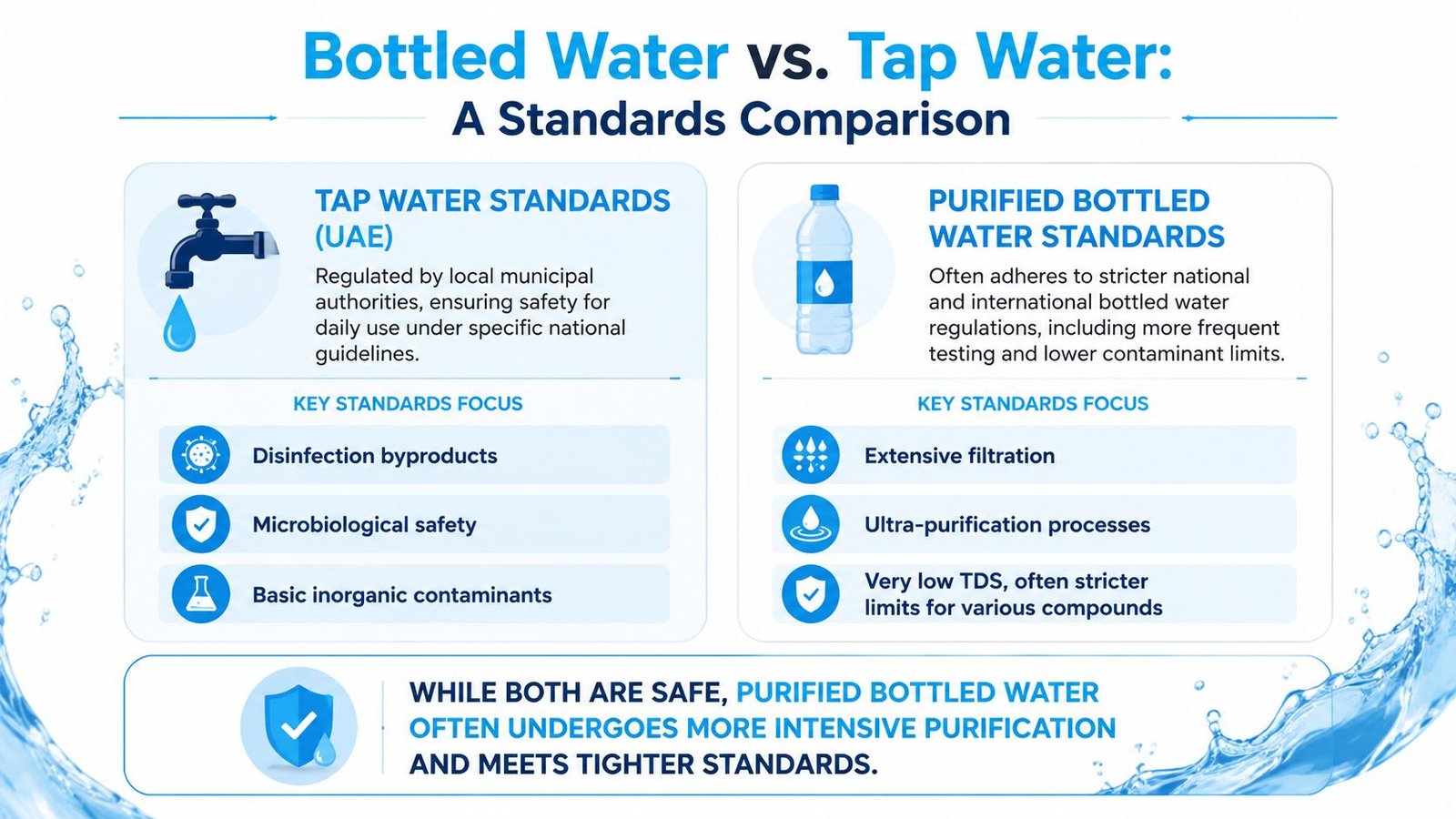
Many readers in Dubai, Sharjah, and Ajman often get mixed up on this point. Safe municipal water and purified bottled water are not judged by exactly the same purity ceiling.
Both are regulated. But the standard target for bottled water can be tighter in specific areas.
The clearest difference to look for
One of the easiest examples is TDS. Under UAE.S 1026:2020 bottled water standards, TDS in bottled drinking water must not exceed 500 mg/L, while the general tap water standard under UAE.S 5005:2021 allows up to 1000 mg/L.
That doesn't mean tap water is automatically poor quality. It means bottled water is being held to a tighter dissolved solids limit in that category.
If you want to see how bottled options are presented for homes and workplaces, this page on bottled drinking water shows the type of product many UAE customers choose for regular delivery.
Side by side comparison
| Water type | Standard point highlighted in this article | What it means in practice |
|---|---|---|
| Municipal tap water | TDS may be allowed up to 1000 mg/L under the general standard | Safe for supply under municipal rules, but not aimed at the same purity target as bottled water |
| 5-gallon water | TDS must not exceed 500 mg/L under bottled water standards | A tighter purity benchmark for delivered bottled drinking water |
This is the practical difference many consumer guides miss. “Safe to drink” and “more tightly purified” are related ideas, but they are not identical.
Why families and offices often choose bottled water
For homes, the appeal is consistency. You know the water is packaged and delivered as a drinking product with its own standard.
For offices, bottled supply also simplifies planning. It's easier to provide a dedicated source of drinking water for staff and guests without relying on whatever assumptions people may have about building supply conditions.
When you compare water options, compare the standard category first. That's often more useful than comparing marketing language.
If you're looking at water delivery Sharjah, water delivery Ajman, or 5 gallon water delivery UAE services, this distinction helps you ask the right question. Not just “Is it safe?” but also “Which standard is this product designed to meet?”
That shift in thinking is helpful. It moves you from general reassurance to a more informed choice based on purity goals, taste preference, and daily use.
The Importance of Low-Sodium Water for Your Diet
Sodium in water doesn't get as much attention as it should. Many people think about sodium only in food, but water can matter too if you're trying to be careful with your overall intake.
This is especially relevant for families managing shared meals and for office managers choosing a regular supply for a team with different health preferences.
A useful comparison appears in this guide to low-sodium water in the UAE. It highlights a gap many people don't realise exists between municipal and purified bottled water expectations.
According to the same broader discussion in this UAE water quality overview, municipal water allows up to 200 mg/L of sodium, while purified bottled water often targets less than 20 mg/L, a distinction described as important for the 30% of UAE adults with increased sodium intake risks.
Why this matters in daily life
You don't need to make dramatic assumptions about health to see the value. If you're already trying to make lower-sodium choices, it makes sense to pay attention to the water you drink every day as well.
For a home, that can mean a simpler routine. For a workplace, it can mean offering an option that suits more people without anyone needing to overthink it.
A simple rule for choosing
- If sodium matters in your household: Check whether the bottled water is positioned as low-sodium.
- If you manage an office pantry: A lower-sodium option is usually the more inclusive choice for staff and visitors.
- If you compare only taste: Low-sodium water may also feel cleaner and lighter to some people, though preference varies.
This is one of those small decisions that can be very practical. You're not trying to turn water into medicine. You're choosing an option that fits a health-conscious routine more comfortably.
How to Choose a Reliable Water Delivery Supplier
Once you understand the standards, the next step is choosing a supplier that takes them seriously. That matters whether you need drinking water delivery UAE service for a villa, a clinic, or an office floor.
A reliable supplier should make quality feel clear, not mysterious. If basic questions are hard to answer, that's usually not a good sign.
Questions worth asking
Start with practical questions, not sales language.
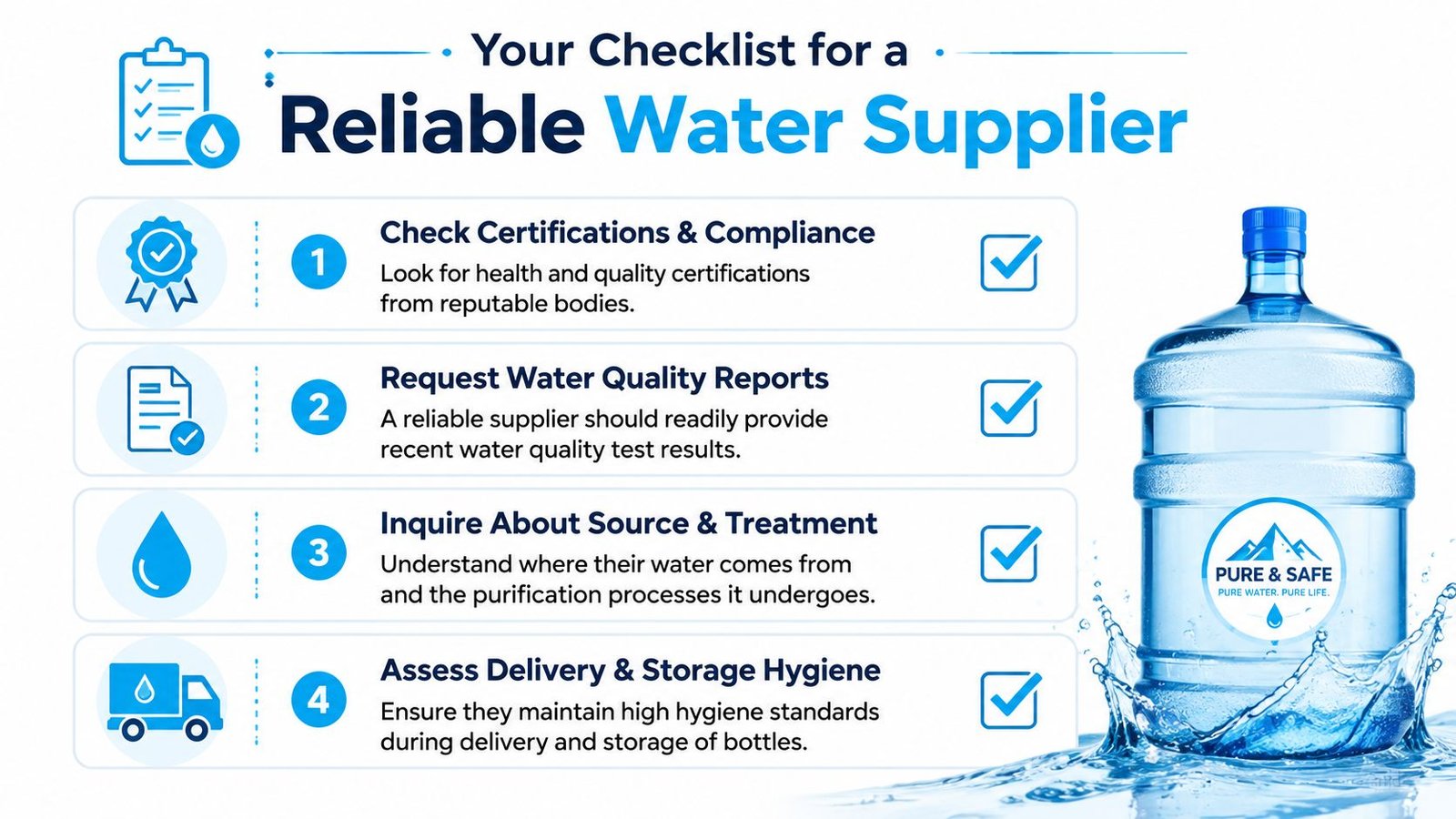
- Ask about testing: A serious supplier should be comfortable discussing water quality checks and report availability.
- Ask about compliance: In the UAE, property operators and licensees under the 2025 rules are tied to quarterly microbiological testing, annual chemical analysis, and a Drinking Water Safety Plan.
- Ask about delivery hygiene: Bottled water quality isn't only about what leaves the facility. It's also about how bottles are handled, stored, and delivered.
What families should notice
For home use, consistency matters as much as the first order. You want deliveries to arrive when expected, bottles to be in good condition, and communication to be simple if you need to reorder.
If you're arranging water delivery Ajman or water delivery Sharjah for your home, trust often comes from these practical details. Clear answers beat flashy claims every time.
A trustworthy supplier usually sounds straightforward. They explain the product, the checks, and the delivery process without trying to distract you.
What office managers should notice
Offices need reliability under routine pressure. You may be ordering for a small team, a busy reception area, or a workplace with frequent visitors.
Look for signs that the supplier understands business needs:
| What to check | Why it matters for offices |
|---|---|
| Regular scheduling | Helps avoid last-minute shortages |
| Responsive support | Makes reordering or fixing issues faster |
| Clear quality information | Builds confidence with management and staff |
| Service area fit | Important if you need office water delivery Dubai or across multiple UAE locations |
A simple decision test
If a supplier can explain their product clearly, discuss quality standards confidently, and offer easy ordering, that's a strong start. If everything stays vague, keep looking.
For homes and businesses alike, the best choice is usually the one that combines compliant quality, dependable delivery, and straightforward communication.
Get Clean, Low-Sodium Water Delivered Today
When you understand drinking water quality standards, choosing becomes easier. You stop guessing and start picking the option that fits your home or workplace best.
For many UAE families and office managers, that means choosing 5-gallon water with a tighter purity standard and a low-sodium profile. It's a practical way to prioritise consistency, clarity, and daily peace of mind.
If you want 5-gallon drinking water delivered in Dubai, Sharjah, or Ajman, the easiest next step is to order through WhatsApp. Visit oxypluswater.com and send a message to arrange your delivery.
Frequently Asked Questions
Is tap water in the UAE safe to drink
Municipal water is regulated and monitored under UAE rules. The key point is that bottled drinking water can still be held to stricter purity limits in some areas, so “safe” and “more tightly purified” aren't always the same thing.
What does TDS mean on a water label or report
TDS means Total Dissolved Solids. It helps you understand how much dissolved material is present in the water and is one useful way to compare bottled water with municipal supply standards.
Why do people choose 5-gallon water instead of regular tap water
Many people want a dedicated drinking water option with a tighter bottled water standard, more predictable taste, and easier supply for homes or offices. That's especially common in shared households and workplaces.
Does low-sodium water really matter
It can matter if you're trying to manage your sodium intake as part of a balanced lifestyle. It's also a sensible choice for offices because it suits a wider range of preferences without adding complexity.
How can I tell if a water delivery supplier is reliable
Check whether they can explain testing, compliance, handling, and delivery clearly. A good supplier should be open about quality information and easy to reach when you need support.
Is bottled water always better than tap water
Not in every possible sense. The more accurate way to think about it is that bottled water may follow a stricter product standard for purity, while tap water is regulated under a different supply standard.
What should office managers look for first
Start with reliability, quality clarity, and service coverage. If you need regular office water delivery Dubai teams can depend on, consistent scheduling and easy communication matter just as much as the water itself.
If you want dependable 5-gallon bottled purified drinking water for your home or office, Oxy Plus Water delivers across Dubai, Sharjah, and Ajman. To place an order or ask a question, contact the team on WhatsApp through the website at oxypluswater.com.