You're probably familiar with this moment. You're loading the car in Dubai for a family day out, or you're in Sharjah trying to make sure your office pantry has enough water for the team, and the 1.5 litre water bottle feels like the easy choice.
It looks practical. It's big enough for one person, easy to grab from a shop, and common in homes, gyms, and workplaces across the UAE. But once you use it every day, the trade-offs become harder to ignore, especially for families and office managers who need a smarter routine.
Table of Contents
- The 1.5 Litre Bottle in Your Daily Life
- Weighing the Good and The Bad of 1.5 Litre Bottles
- Health and Safety Tips for Your Bottled Water
- Hidden Costs and Waste of Convenience
- A Smarter, More Sustainable Hydration Strategy
- Your Guide to Effortless Water Delivery
- Your Questions Answered and How to Order
- FAQ
The 1.5 Litre Bottle in Your Daily Life
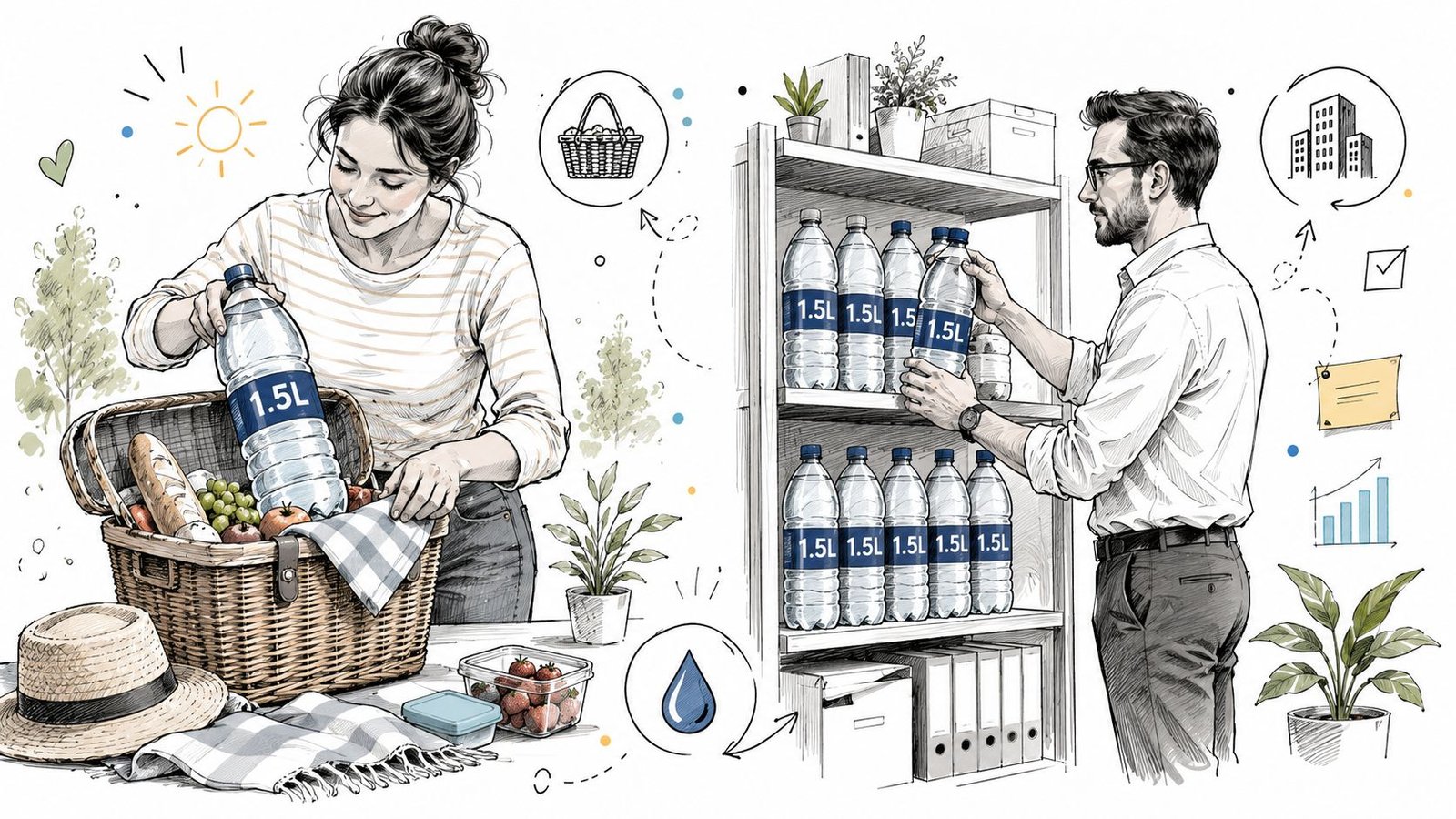
A 1.5 litre bottle sits in the middle. It's larger than a small personal bottle, but it's still something one person can carry for a school run, office desk, gym visit, or day trip.
For families, that often means one bottle in the car, one in the picnic bag, and one more as backup. For offices, it means stacking bottles in cupboards or meeting rooms because they seem simple to hand out when people need water quickly.
Why this size became so common
The size feels convenient because it gives you more than a small bottle without feeling too heavy at first. That balance is a big reason it became a regular choice in shops, offices, and homes across Dubai and Sharjah.
Plastic bottle use also has a long history behind it. The TXST Digital Repository overview of plastic bottle production notes that the global production of plastic water bottles, including the widely used 1.5-litre size, consumes approximately 1.5 million barrels of oil annually just for the American market, while bottled water use in the UAE has surged since the 1970s.
Daily reality: The 1.5 litre bottle feels like a safe middle-ground choice because it suits one person for several hours without looking oversized.
If you compare it with a 1 litre water bottle option, the 1.5 litre version gives you more volume in one container. That can reduce refills during the day, but it also makes the bottle bulkier in your hand, bag, or car.
Home use and office use aren't the same
At home, a 1.5 litre bottle often works as a short-term solution. You buy a few, keep them in the kitchen, and grab them when you leave.
In an office, the pattern changes. One or two bottles disappear quickly during meetings, client visits, or long workdays, so what looked tidy at first can turn into repeated reordering, storage clutter, and a growing pile of empties.
- For families: It's easy for school runs, short outings, or keeping one bottle in the fridge.
- For office managers: It's useful for temporary coverage, especially when you need sealed bottles on hand.
- For both: It solves today's hydration need, but not always the week's hydration plan.
Weighing the Good and The Bad of 1.5 Litre Bottles
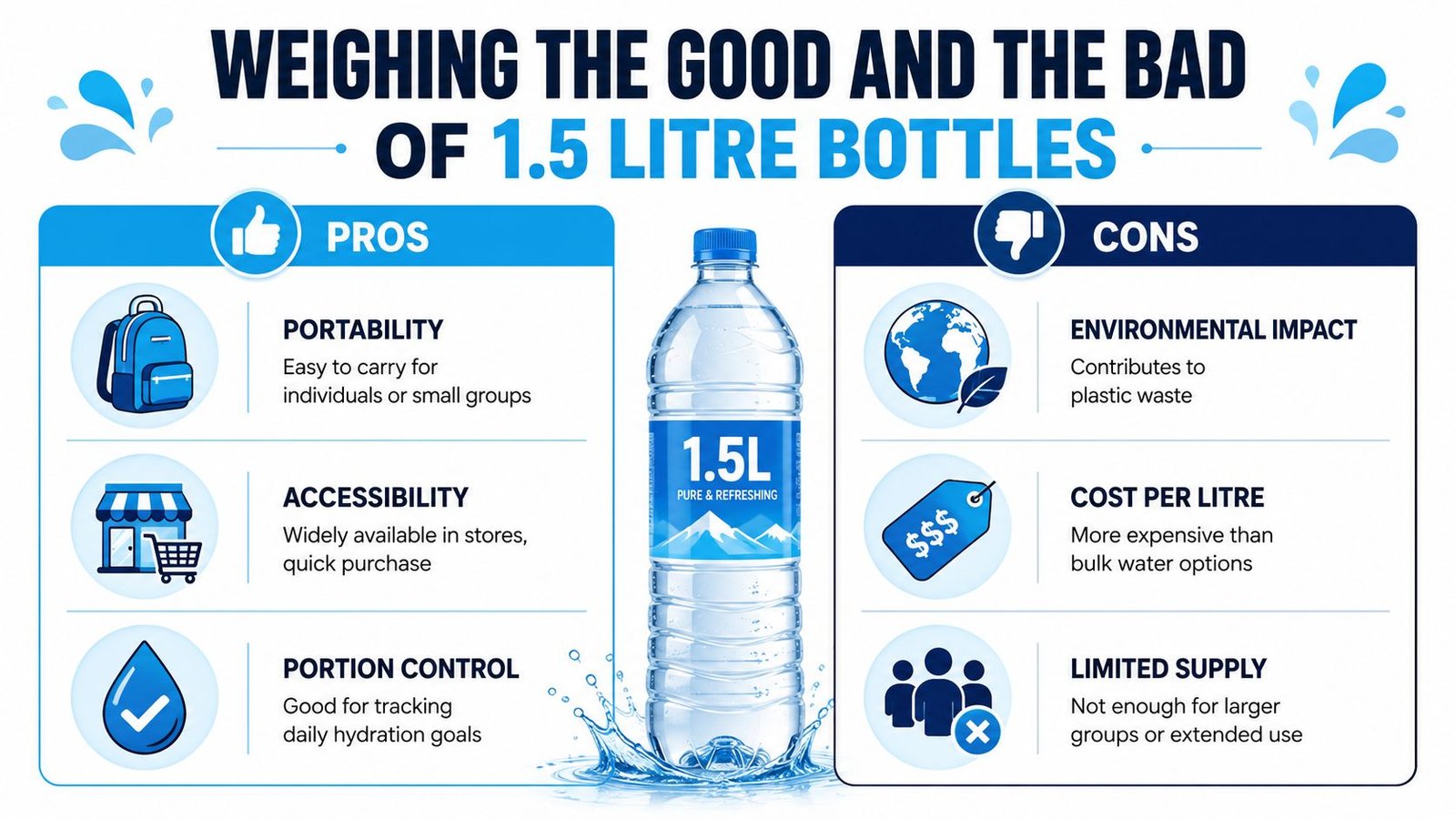
The 1.5 litre bottle is convenient, but convenience can hide friction. What works for one person on one day doesn't always work for a family home or a busy office all week.
Some benefits are obvious. It's sealed, familiar, and easy to pick up from almost any shop in Dubai, Ajman, or Sharjah.
Where it works well
A 1.5 litre bottle can make sense when one adult wants a day's worth of water in a single bottle. It can also help office staff track what they've finished without multiple small bottles scattered around desks.
Here's the simple upside:
| Good point | Why people like it |
|---|---|
| Ready to use | You buy it, open it, and drink straight away |
| Clear portion | One bottle gives a visible amount for one person |
| Easy to find | Shops, petrol stations, and supermarkets usually stock it |
For short-term use, this bottle size feels organised because you can see exactly what one person has available.
Where it starts to annoy you
The size that seems helpful in the shop can feel awkward during the commute. Many people in Dubai, Sharjah, and Ajman already know this from experience.
According to this commuter fit survey summary, 42% of commuters carry water bottles, and 68% report difficulty fitting bottles larger than 1 litre into side pockets or vehicle cup holders. That helps explain why a 1.5 litre water bottle often feels fine at home but awkward in transit.
- In the car: It may not sit securely in a cup holder.
- In a backpack: The width can stretch or slip from a side pocket.
- At the office: Cases take up more cupboard and floor space than people expect.
For homes, that bulk means shopping trips feel heavier. For office managers handling drinking water delivery UAE needs, it can mean more time spent restocking small bottles than solving the wider hydration problem.
A fair trade-off
If you need something quick for one person, the format still makes sense. But once you're buying for children, visitors, or a full office team, the same bottle starts to feel less like a solution and more like a repeating task.
Health and Safety Tips for Your Bottled Water
In the UAE, storage matters almost as much as the water itself. Heat changes how plastic behaves, so where you keep a bottle during the day really matters.
A common mistake is leaving a 1.5 litre bottle in a parked car. It feels harmless, especially if you plan to come back soon, but high heat can affect the bottle and the taste of the water.
Don't leave plastic bottles in hot places
Standard 1.5-litre PET bottles used in the UAE have a glass transition temperature of 70 to 75°C. As explained on this page about BPA-free water bottles, exposure to heat above that range, such as direct sunlight in a car, can deform the bottle and may lead to the leaching of acetaldehyde, which is described as harmless but can alter taste.
That doesn't mean you need to panic. It means you should treat bottled water like other heat-sensitive items and store it with care.
Practical rule: If the bottle feels hot to the touch, don't treat that as normal storage.
Simple storage habits that help
You don't need a complicated routine. A few basic habits are enough for most homes and offices.
- Keep it shaded: Store bottles in a cool, dark indoor space.
- Check the bottle shape: If the plastic looks warped, don't use it.
- Use clean rotation: Older bottles should be used before newer stock.
- Avoid repeated heat exposure: Don't move the same bottle from hot car to office to hot car again.
What BPA-free means in plain language
People often confuse different plastic safety terms. In simple terms, BPA-free means the packaging is made without BPA, which is a chemical many people prefer to avoid in food and drink contact materials.
That label doesn't mean every storage habit is safe. Even BPA-free bottles still need proper handling, especially in Dubai summer heat or in office loading areas where deliveries may sit for too long.
For families, the easiest rule is to keep bottled water indoors. For offices, assign one clean, shaded storage area so staff don't leave bottles near windows or in vehicles.
Hidden Costs and Waste of Convenience
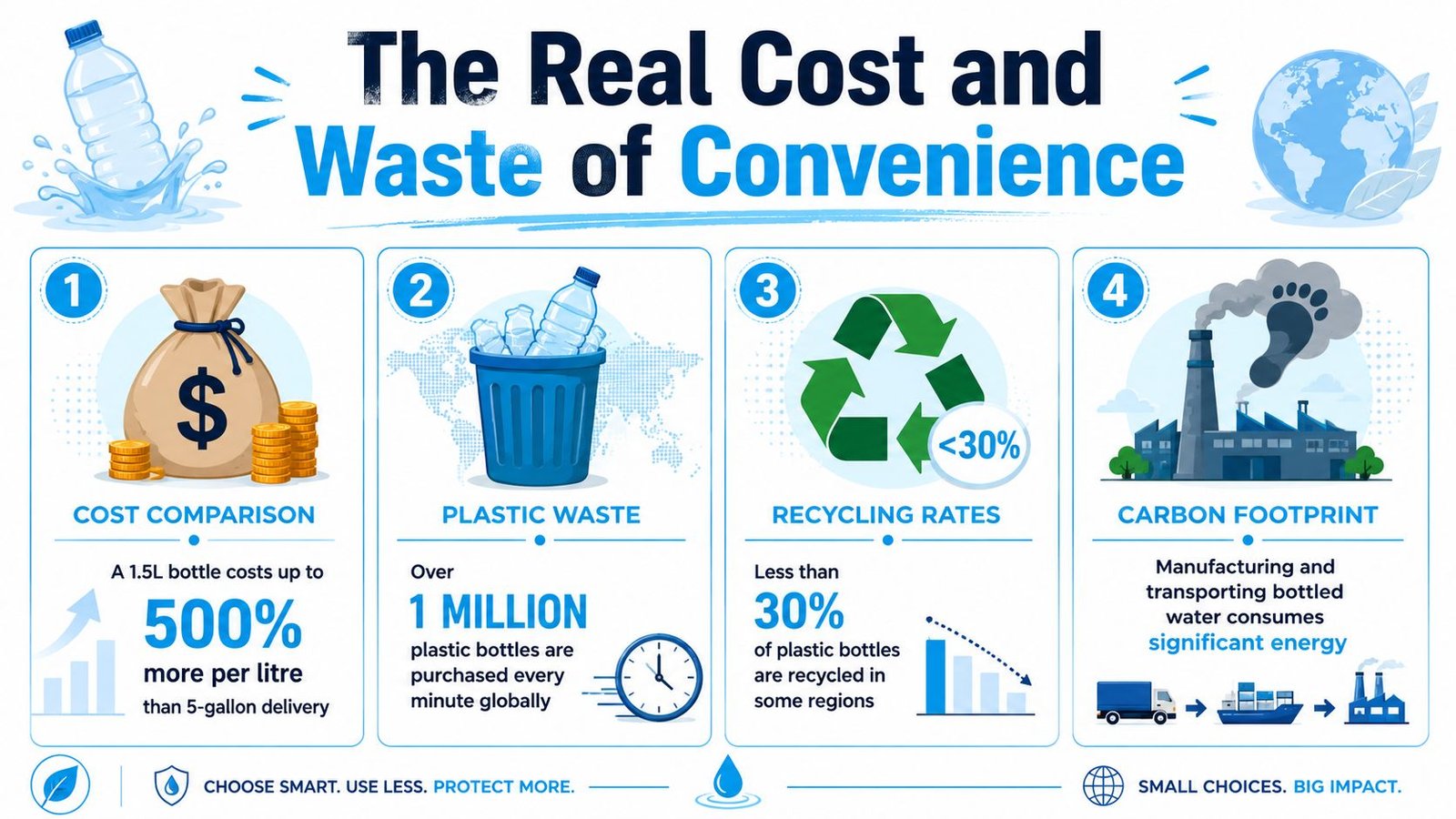
A common UAE routine looks harmless at first. A parent adds a few 1.5 litre bottles to the weekly shop. An office assistant brings in another shrink-wrapped pack for the pantry. By itself, each purchase feels small. Over time, it works like paying for water in fragments, while also collecting a trail of plastic around your home or workplace.
Small bottles create a bigger system to manage
A 1.5 litre bottle is convenient for one person on one trip. Daily hydration for a family or an office is a different job. Now you are not only buying water. You are also carrying packs, finding storage space, cooling enough bottles, clearing empties, and remembering to buy more before you run out.
That is the trade-off many people miss.
If you want packaging that is easier to process after use, this guide to recyclable water bottles can help. Even then, recycling does not remove the repeated work that comes with many single-use bottles.
Cost is not only the shelf price
The price tag on a bottle shows only one part of the cost. The rest shows up in routine.
For families, that often means extra shopping trips, stacks of bottles in the kitchen, and surprise shortages during hot weekends, school holidays, or family visits. A few bottles disappear quickly when several people are pouring from separate containers throughout the day.
For offices, the pattern is even clearer. A pantry that depends on small bottles needs frequent restocking, more shelf space, and more cleanup after meetings. Half-finished bottles are common, and each one represents both wasted water and wasted packaging.
| Daily issue | What it leads to |
|---|---|
| Frequent top-up purchases | More time spent remembering, ordering, and carrying water |
| Pack storage | Floor and shelf space lost to cases of bottles |
| Individual bottle use | More partial bottles, more waste, more bin volume |
| Busy periods | Faster stockouts during meetings, guests, or peak summer demand |
Why many UAE homes and offices switch to bulk
The easiest way to understand the difference is to compare the job each format is built to do. A 1.5 litre bottle serves an individual. A 5-gallon setup serves a group.
That design difference matters.
For a home, bulk delivery reduces the cycle of buy, carry, chill, throw away, repeat. For an office, it turns water supply into a planned service instead of a constant small errand. You usually handle fewer containers, create less visible waste, and spend less effort keeping everyone supplied.
Small bottles still have a place for travel, school runs, and one-off use. But if your household or workplace goes through them every week, convenience often becomes the more expensive and wasteful option over the full cycle.
A Smarter, More Sustainable Hydration Strategy
A common UAE routine looks like this. A family finishes several 1.5 litre bottles in a day, or an office pantry starts the week full and ends it with empty bottles, half-used bottles, and another urgent order. The bottle feels convenient at the moment, but the full cycle often creates more work and more waste than people expect.
For shared daily use, a 5-gallon system usually fits the job better. It shifts water from a repeated retail purchase to a planned household or office supply, which is a much better match for how groups drink water.
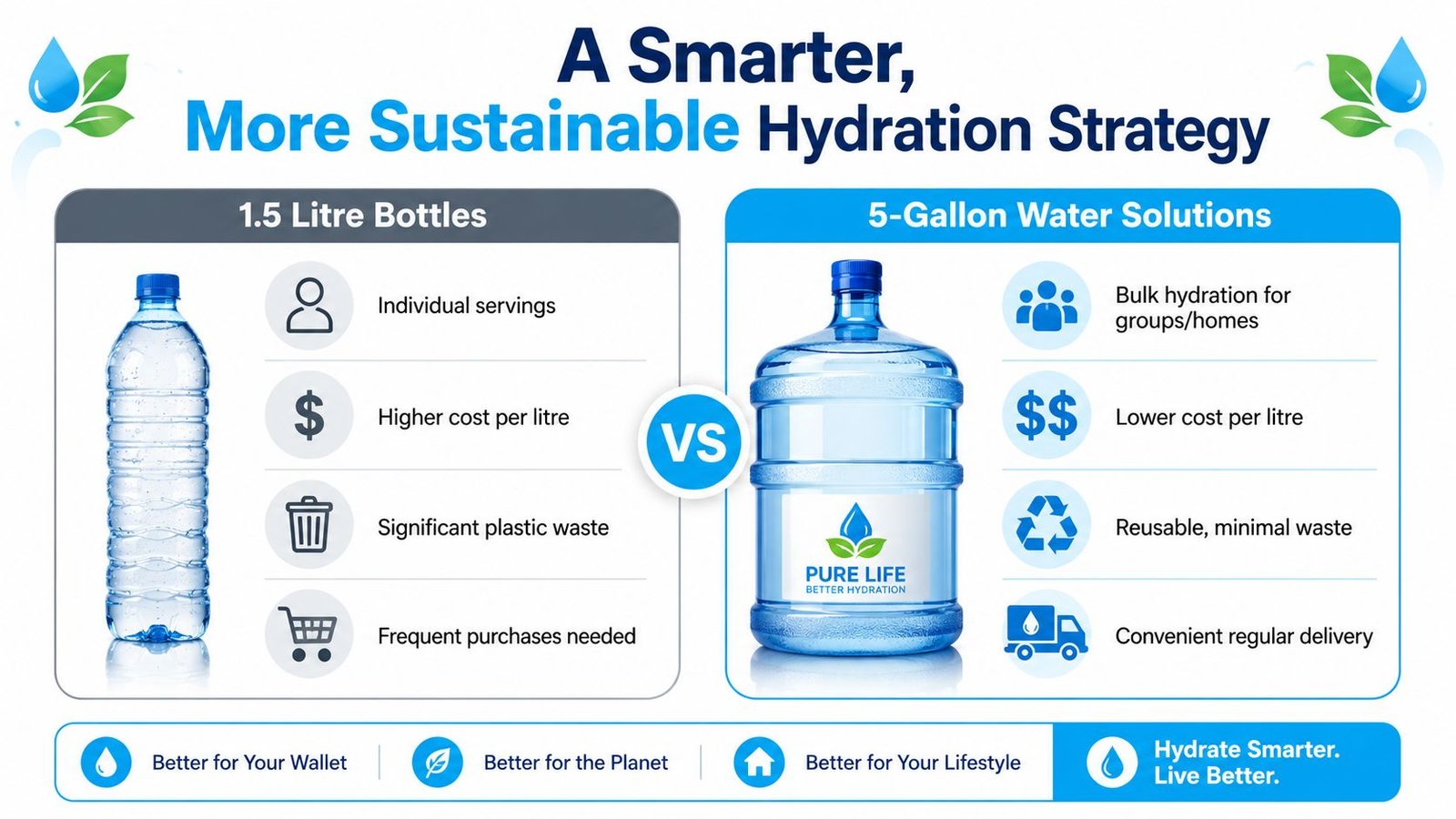
Here's a quick visual comparison.
Why bulk works better for shared use
A 1.5 litre bottle works well for one person on the move. A 5-gallon bottle works better like a shared pantry item. The difference is simple. One format is built for carrying. The other is built for supplying.
That matters in real homes and offices. If several people are drinking from the same supply every day, one larger container usually means fewer openings, fewer empties, and less water left unfinished in separate bottles. In an office meeting room, it also reduces the familiar pile of used bottles after guests leave.
You can also watch this short video for a broader look at sustainable water habits in daily life.
Looking at cost over the full cycle
This is the part many general water guides skip.
The price tag on one 1.5 litre bottle can look manageable, especially during a quick supermarket trip. But families and office admins in the UAE rarely buy just one bottle. They buy cases, store them, chill them, replace them, and throw them away. Over time, the actual comparison is not bottle versus bottle. It is repeated small-pack buying versus a refill and delivery routine built for steady use.
That is why bulk water often makes more practical sense for shared consumption, even without relying on a universal percentage claim. The exact savings depend on your supplier, how much water your household or team uses, and how often you restock. The useful question is simpler. Which setup creates less repeat spending, less handling, and less waste each week?
For shared hydration, a better question is, “Which system keeps water available with less cost and less waste over time?”
Less plastic to handle, less waste to manage
A 5-gallon delivery model also changes the waste pattern. Instead of going through many single-use bottles, homes and offices use larger containers that are typically collected, sanitised, and returned to service by the supplier. That does not remove all environmental impact, but it usually cuts the volume of everyday plastic waste you need to store and discard.
For families, that can mean fewer overflowing recycling bags or kitchen bins. For offices, it means less cleanup after meetings and less visible clutter in pantry areas.
Better for homes, easier for offices
In a home, the benefit is practical calm. Parents are not constantly checking whether enough small bottles are left for the evening, the school run, or weekend guests.
In an office, the benefit is control. A shared dispenser gives staff one reliable place to get water, and it makes stock planning easier than managing multiple cases of individual bottles.
The main idea is straightforward. If your water use is regular and shared, a bulk 5-gallon setup usually matches that pattern better than repeated 1.5 litre bottle purchases.
Your Guide to Effortless Water Delivery
Once you stop thinking bottle by bottle, the process gets easier. The goal isn't to keep shopping better. The goal is to stop needing constant small-bottle shopping in the first place.
That's especially helpful for families with packed schedules and office managers juggling admin tasks. You want clean drinking water UAE service that feels routine, local, and easy to manage.
A simple way to set up your supply
The easiest systems are the ones you can repeat without stress. For homes and offices, the setup usually works best when you choose regular delivery instead of waiting until you're nearly out.
A simple approach looks like this:
- Estimate your pattern: Think about how quickly your household or team uses water.
- Choose your area: Delivery is available in Dubai, Sharjah, and Ajman.
- Use WhatsApp for contact: It's fast, familiar, and easy to manage during the workday.
- Set a routine: Regular delivery removes the last-minute rush.
Why local delivery matters
If you've ever run out before a busy office day or a weekend gathering, you already know why local coverage matters. A dependable schedule helps more than occasional emergency buying.
For drinking water delivery UAE needs, local service gives you practical benefits:
- For homes: Less lifting, less carrying, fewer rushed supermarket trips.
- For offices: Better planning for staff, meetings, and visitor days.
- For both: A steadier hydration routine that doesn't depend on whoever remembers to buy water next.
A good delivery routine feels boring in the best way. Water arrives, people drink it, and nobody has to think too hard about it.
If you're searching for water delivery Dubai, water delivery Sharjah, or water delivery Ajman, keep the decision simple. Look for a service focused on consistent 5-gallon bottled purified drinking water, straightforward communication, and easy reordering through WhatsApp.
Your Questions Answered and How to Order
A familiar UAE scenario helps here. A family dinner is coming up, or the office pantry is running low again. Someone notices there are only a few 1.5 litre bottles left, and the quick fix turns into another small purchase, another stack of plastic, and another task to remember.
That pattern is why many households and workplaces switch to bulk delivery. A 1.5 litre bottle works well for single-person use on the go. Shared daily use is different. In a home or office, water is less like a grab-and-go item and more like a basic household supply, similar to keeping rice, milk, or cleaning essentials stocked.
Ordering is simple. You send a WhatsApp message, confirm your location in Dubai, Sharjah, or Ajman, and arrange delivery for your home or office.
The practical benefit is not only convenience. It also changes the rhythm of how you buy water. Instead of repeatedly paying for many smaller bottles and dealing with the empty bottle pile afterward, you get a setup that is easier to keep steady for everyday drinking.
If you are ready to replace repeat small-bottle buying with a simpler routine, Oxy Plus Water offers 5-gallon bottled purified drinking water delivery for homes and businesses in Dubai, Sharjah, and Ajman. You can place your order through WhatsApp and set up a schedule that fits your usual water use.
FAQ
Is a 1.5 litre water bottle good for one person?
Yes, it can be a practical size for one person during a workday or outing. The challenge starts when a whole family or office depends on many of them every day.
Why do 1.5 litre bottles feel awkward in bags?
They're often wider than smaller bottles, so they don't always fit side pockets or cup holders well. That's a common frustration for commuters in the UAE.
Can I leave a plastic water bottle in a hot car?
It's better not to. High heat can deform the bottle and may affect the taste of the water.
Is bulk water better for offices?
For most offices, yes. It reduces repeated small purchases, cuts clutter, and makes shared hydration easier to manage.
Is bulk water useful for families too?
Yes, especially if your household goes through water quickly. It can make daily life simpler and reduce the pile of empty bottles at home.
How do I order from Oxy Plus Water?
You can order through WhatsApp and arrange delivery to your home or office in Dubai, Sharjah, or Ajman.
If you're ready to move from small-bottle hassle to a simpler routine, Oxy Plus Water makes it easy. You can order 5-gallon bottled purified drinking water delivery for your home or business in Dubai, Sharjah, or Ajman by sending a quick message on WhatsApp through oxypluswater.com.